
Delaware DMV Motorcycle Practice Test 5
Test 5 of 6. Pick an answer for each question to see if it is right and why; your score appears at the end. You need 20 correct answers to pass, the same ratio as the real Delaware test.
- Questions25
- Correct to pass20
- Passing score80%
- Minimum age18 years
-
1. What fine applies to a later Delaware offense of driving without the required insurance?
Show answer
Answer D: 3,000 to 4,000 dollars
A subsequent uninsured driving offense carries a fine of not less than 3,000 dollars and not more than 4,000 dollars.
-
2. What does Delaware law require of a motorcycle rider aged 19 or older who chooses not to wear a helmet?
Show answer
Answer D: The rider must still have an approved safety helmet in his or her possession
Riders 19 and older who do not wear a helmet must still carry an approved safety helmet with them.
-
3. After a first Delaware DUI conviction with an alcohol concentration below 0.15, how soon may the driver apply for an ignition interlock license?
Show answer
Answer B: 30 days after the revocation takes effect
The driver becomes eligible for the interlock license at least thirty days after the revocation takes effect; a higher concentration pushes that to forty-five days.
-
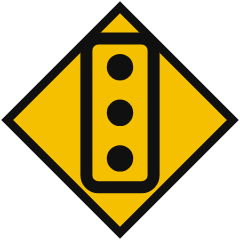
4. A driver passes this sign and the signal beyond it is already showing green. What is the safest response?
Show answer
Answer C: Ease off the accelerator and be ready to stop, because an indication that has been showing for a while is about to change
A signal that has been displaying the same indication for some time is close to changing, so arriving at a controlled speed with the brake covered is safer than accelerating to beat it.
-
5. How does Delaware classify a third driving under the influence offense?
Show answer
Answer A: A class G felony
A third DUI offense is a class G felony carrying a fine of up to 5,000 dollars and one to two years of imprisonment.
-
6. A driver moves into the space you were keeping ahead of you. What should you do?
Show answer
Answer D: Ease off and rebuild the gap in front of you
Losing a following gap is common in traffic; the answer is simply to drop back and recreate it rather than drive too close.
-
7. What do flashing yellow lights on a school bus mean?
Show answer
Answer A: The bus is about to stop to load or unload, so prepare to stop
The amber lights are the warning phase that comes before the red lights and the stop arm, so drivers should slow down and get ready to stop.
-
8. What is sensible when you drive in an unfamiliar town for the first time?
Show answer
Answer C: Drive a little slower and give yourself more time to read the signs
In unfamiliar surroundings you need longer to take in signs, junctions and markings, and lower speed buys that time.
-
9. What mandatory suspension follows a Delaware conviction for driving 25 miles per hour over the posted limit?
Show answer
Answer A: 1 month
The suspension starts at one month at 25 over and grows by one month for each additional five miles per hour above that threshold.
-
10. At what level of apparent property damage must a Delaware crash on a public highway be reported?
Show answer
Answer D: 2,000 dollars or more
A crash on a public highway must be reported when the apparent property damage reaches that figure, and always when anyone is injured or killed.
-
11. Apart from work zones, a Delaware speed camera may be used in a residence district in which county?
Show answer
Answer C: New Castle
The statute allows electronic speed monitoring in a work zone, and in a residence district only in New Castle County or in a municipality.
-
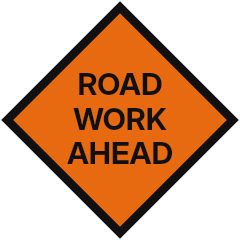
12. This sign is still standing late at night, and nobody is working. What should the driver assume?
Show answer
Answer B: The layout may still be altered, so the same care and reduced speed apply
Narrowed lanes, shifted alignments, dropped pavement edges and parked equipment remain overnight, so the hazard does not end when the crew goes home.
-
13. When should a passenger get on the motorcycle?
Show answer
Answer D: After the engine has been started and the operator is ready
Mounting after the engine is running and the operator is settled keeps the motorcycle stable and spares the operator a long balancing act with the extra weight aboard.
-
14. Your vehicle stalls on a railroad crossing and will not restart. What should you do first?
Show answer
Answer A: Get everyone out and away from the tracks immediately
Everyone must leave the vehicle and move well clear of the tracks at once, walking toward the train at an angle so that debris from an impact travels away from you.
-
15. Why is a wet road at night harder to read than the same road in daylight?
Show answer
Answer A: The wet surface reflects light away and swallows the lane markings
A film of water sends your headlight beam onward instead of back to you, so lines, edges and people in dark clothing almost disappear.
-
16. A school bus ahead of you has its red lights flashing and its stop arm extended. What are you required to do?
Show answer
Answer A: Stop and stay stopped until the lights stop flashing and the bus starts moving
Flashing red lights and an extended stop arm mean children are getting on or off, so traffic must stop and wait until the bus withdraws the signals and moves again.
-
17. Besides authorized emergency vehicles, which stopped vehicles does Delaware's move over law protect?
Show answer
Answer C: Tow trucks, utility vehicles and transportation department vehicles
The law covers stationary emergency vehicles together with tow trucks, public utility vehicles and Department of Transportation vehicles displaying warning signals.
-
18. How long is the license suspension for a first Delaware conviction of passing a stopped school bus?
Show answer
Answer A: 1 month
A first offense costs one month of driving privileges, a second costs six months and a third or later offense costs twelve months.
-
19. What is the Delaware statutory speed limit on four-lane and divided roadways where no other limit is posted?
Show answer
Answer B: 55 mph
Delaware law sets 55 mph on four-lane roadways and on divided roadways.
-
20. If a Delaware driver cannot safely change lanes near a stopped emergency vehicle on a road posted at 50 mph or higher, what speed is required?
Show answer
Answer D: At least 20 mph below the posted speed limit
When a lane change is not possible, the driver must slow to at least 20 mph below the posted limit on roads posted at 50 mph or more.
-
21. How does Delaware treat points once a violation is more than twelve months old?
Show answer
Answer C: They count at half value for the following year
Calculated points count at full value for twelve months from the date of the violation and then at half value for the next twelve months.
-
22. A load has been packed onto the seat behind you. What else must it not do?
Show answer
Answer A: Restrict how you move on the seat or reach the controls
Baggage that pins the rider in place or gets in the way of the handlebars and levers takes away the control the rider needs in an emergency.
-
23. What does Delaware law prohibit regarding electronic communication devices while driving?
Show answer
Answer D: Driving on any highway while using a handheld electronic communication device with the vehicle in motion
Delaware bans driving on a highway while using a handheld electronic communication device when the vehicle is in motion; hands-free use is excepted.
-
24. How long is the revocation for a first Delaware DUI where the alcohol concentration was 0.20 or more?
Show answer
Answer C: 24 months
An alcohol concentration of 0.20 or more, or a refusal of the chemical test, raises the first offense revocation to twenty-four months.
-
25. You reach a red light with a sign reading NO TURN ON RED. What may you do?
Show answer
Answer D: Wait for the green; no turn is allowed while the light is red
That sign removes the usual permission to turn on red at the intersection, so you must wait for a green indication.