
Delaware DMV Motorcycle Practice Test 2
- Questions25
- Correct to pass20
- Passing score80%
- Minimum age18 years
-
1. An exit ramp is separated from the highway by a triangle of pavement painted with white stripes. What may you do there?
Show answer
Answer C: Nothing; keep off it and choose either the lane or the ramp
The striped area between a ramp and the through lanes is not for driving, stopping or last-second changes of direction.
-
2. You are following a tractor-trailer so closely that its rear doors fill your windshield. What is the main problem?
Show answer
Answer D: You cannot see the road ahead and the truck driver cannot see you
A truck has a deep blind spot directly behind it, and tailgating also hides everything in front of the truck from you. Drop back so you can see and be seen.
-
3. What is the benefit of looking far down the road rather than just ahead of the hood?
Show answer
Answer A: You steer with smaller corrections and you see trouble in plenty of time
A distant view steadies your steering and gives you time to plan, because you meet hazards after you have already seen them.
-
4. Your passenger keeps leaning out to one side to see the road ahead. What should you do?
Show answer
Answer B: Ask them to stay in line with you and look over your shoulder instead
Leaning out shifts the combined weight sideways and unsettles the machine, and a passenger can see far enough by looking past the rider's shoulder.
-
5. How much space should you hold behind the rider who is directly ahead of you in your own portion of the lane?
Show answer
Answer D: At least two seconds
Riders sharing the same track keep a following distance of at least two seconds so they have the time and the room to react to a hazard.
-
6. Your vehicle stalls on railroad tracks and you see a train approaching. What should you do?
Show answer
Answer D: Get everyone out and run toward the train at an angle away from the tracks
Leave the vehicle at once. Running toward the oncoming train and away from the tracks keeps you clear of the wreckage, which is thrown forward in the direction the train is moving.
-
7. Where in the United States may a motorcycle ride between lanes of traffic?
Show answer
Answer C: Only where a state has specifically authorized it
Riding between lanes is prohibited in most states and permitted only where a state law expressly allows it, so a rider must know the rule for the state being ridden in.
-
8. Why should pant legs be secured and bootlaces tucked away?
Show answer
Answer A: Loose fabric and laces can tangle in the chain, the controls or a wheel
Anything hanging near the moving parts of a motorcycle can be caught and pulled in, which can trap a foot or lock the rear wheel.
-
9. You feel fine twenty minutes after your last drink. Why is that a poor guide to driving?
Show answer
Answer B: Your blood alcohol level can still be rising
Alcohol keeps being absorbed for some time after the last drink, so a driver who feels able at the door can be more impaired a few miles down the road.
-
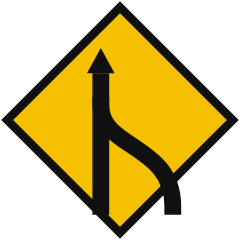
10. What is the safest way to deal with the situation this sign announces?
Show answer
Answer B: Match the speed of the other traffic stream and open a gap so vehicles can blend without hard braking
Blending works when speeds are matched and gaps are opened, so nobody has to brake hard or swerve where the two streams come together.
-
11. You are driving on a rural road with no sidewalk. Where should you expect to meet pedestrians?
Show answer
Answer A: Walking toward you on your side of the road
Where there is no sidewalk, pedestrians are taught to walk facing traffic, so they appear on your side of the road coming toward you.
-
12. When should you move into the lane you need for a turn?
Show answer
Answer D: Well before the intersection, as soon as you know your route
Getting into the correct lane early lets other drivers read your intentions and keeps you from making a sudden lane change at the corner.
-
13. Why should a rider downshift one gear at a time instead of skipping several at once?
Show answer
Answer D: Skipping gears can lock the rear wheel through sudden engine braking
Dropping several gears at once forces engine speed far above what road speed supports, and the rear tire can be dragged into a skid when the clutch comes out.
-
14. A traffic light ahead of the group turns yellow as the leader approaches it. What should the leader do?
Show answer
Answer C: Stop normally and let the group be split by the signal
Keeping the group together never outranks obeying the signal, and the riders left behind simply catch up at the next stop.
-
15. A train has just cleared a crossing that carries two sets of tracks. What should you do?
Show answer
Answer B: Wait and look both ways for a second train
A passing train hides a second train on the other track, so wait until the signals stop and you can see that both tracks are clear.
-
16. What minimum term of imprisonment applies to a second Delaware DUI offense committed within ten years of the first?
Show answer
Answer C: 60 days
A second offense within ten years carries a minimum of sixty days imprisonment, and that minimum cannot ordinarily be suspended.
-
17. Under Delaware's under-21 law, what alcohol concentration is treated as proof of a violation?
Show answer
Answer B: 0.02
For drivers under 21 an alcohol concentration of 0.02 or more is per se evidence of driving after consuming alcohol.
-
18. Your loaded vehicle weighs more than the figure shown on a posted weight limit sign. What must you do?
Show answer
Answer D: Find another route, because crossing is not permitted
A posted weight limit is a legal maximum, not advice, so an overweight vehicle has to take a different route.
-
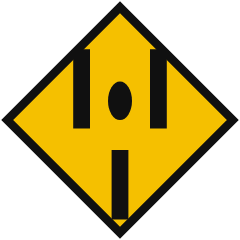
19. What should a driver do first after passing this sign?
Show answer
Answer A: Move into the right-hand lane and stay there
Traffic returns to two-way operation, so the driver keeps to the right of the centerline and stops treating the left side as available.
-
20. Which formation lets a group of riders stay close together while every rider keeps an adequate space cushion?
Show answer
Answer A: A staggered formation
A staggered formation keeps the group compact enough for traffic while still leaving each rider room to the front, the rear and both sides.
-
21. You have shut the engine off with the kill switch because the throttle stuck open. What comes next?
Show answer
Answer D: Keep the clutch in, brake to a stop off the road, and find the cause
With the engine off and the clutch pulled in the motorcycle is only coasting, so brake to a stop clear of traffic and inspect the throttle cable and grip before restarting.
-
22. You are turning right from a one-way street onto a two-way street. Where should the turn end?
Show answer
Answer A: In the lane nearest the right curb of the street you are entering
A right turn starts and finishes as close to the right as practical, so you leave the one-way street from the right lane and arrive in the lane nearest the right curb.
-
23. The left-turn signal facing you shows a flashing yellow arrow. What does it mean?
Show answer
Answer C: You may turn left after yielding to oncoming traffic and to pedestrians
A flashing yellow arrow permits a left turn but gives no protection, so you must yield to oncoming vehicles and to people in the crosswalk.
-
24. Traffic safety experts describe three kinds of driver distraction. Which set is correct?
Show answer
Answer A: Visual, manual and cognitive
Distraction takes the eyes off the road, the hands off the controls or the mind off driving, and many activities do more than one of those at once.
-
25. You are making a U-turn at a signal on a green left arrow. Who must you still watch for?
Show answer
Answer D: People in the crosswalk you will cross as you come around
Even a protected arrow does not clear the crosswalk, and a U-turn sweeps across a crosswalk that pedestrians may already be using.