
Delaware DMV Permit Practice Test 8
Test 8 of 10. Pick an answer for each question to see if it is right and why; your score appears at the end. You need 26 correct answers to pass, the same ratio as the real Delaware test.

- Questions32
- Correct to pass26
- Passing score81%
- Minimum age16 years
-
1. What is the penalty for a first breach of the Level 1 Learner's Permit restrictions, such as the seat belt rule, in Delaware?
Show answer
Answer C: A two-month suspension of driving privileges
The seat belt rule is one of the Level 1 permit restrictions, and failing to follow those restrictions costs two months of driving privileges for a first offense and four months for later ones.
-
2. Where should your hands normally rest on the steering wheel?
Show answer
Answer C: On opposite sides of the wheel, near the 9 and 3 positions
Hands placed opposite each other near the middle of the wheel give smooth, balanced control and keep the arms clear of a deploying air bag.
-
3. During the first six months of a Delaware Level 1 Learner's Permit, when may the holder drive?
Show answer
Answer A: Only while supervised at all times
For the first six months the permit holder must be supervised at all times.
-
4. When is a driver at the highest risk of falling asleep at the wheel?
Show answer
Answer B: Late at night, early morning and mid afternoon
The body clock produces its deepest dips in alertness in the small hours and again in the middle of the afternoon, and crash records follow those dips.
-
5. Where in the United States may a motorcycle ride between lanes of traffic?
Show answer
Answer C: Only where a state has specifically authorized it
Riding between lanes is prohibited in most states and permitted only where a state law expressly allows it, so a rider must know the rule for the state being ridden in.
-
6. A vehicle ahead of you displays a reflective orange triangle on its rear. What does that emblem tell you?
Show answer
Answer B: The vehicle is built to travel at 25 mph or less
The orange triangle is the slow moving vehicle emblem used on farm and construction equipment designed for 25 mph or less, warning you that you are closing on it much faster than it appears.
-
7. You realize at the last moment that you have passed the street where you meant to turn. What should you do?
Show answer
Answer D: Keep going and turn around where it is safe and legal
A missed turn is a minor inconvenience; braking suddenly, backing up or turning across traffic to recover it causes crashes.
-
8. A yellow diamond showing a bicycle is posted on a rural road. What should a driver expect?
Show answer
Answer A: Bicyclists crossing or riding along the roadway there
The bicycle warning sign is used where a bikeway crosses the road or where riders are likely to be in the traffic lanes, so drivers should look carefully and pass wide.
-
9. On a first Delaware speeding offense of 20 or more miles per hour over the limit, how much is added for each mile per hour?
Show answer
Answer C: 3 dollars per mile
The per mile charge rises with the size of the overage, reaching three dollars per mile on a first offense at 20 or more over.
-
10. A black on white regulatory sign at an intersection reads NO TURNS. What may a driver do there?
Show answer
Answer B: Only continue straight through the intersection
The NO TURNS sign bans turns in every direction at that intersection, so the only lawful movement from that approach is straight through.
-
11. Why is passing another vehicle a bad idea in dense fog?
Show answer
Answer C: You cannot see far enough ahead to know the passing lane is clear
A pass needs a clear view of the road well beyond the vehicle you are overtaking, and fog takes exactly that away.
-
12. Where is a road work ahead sign placed?
Show answer
Answer B: In advance of the work space or detour, so drivers are warned before reaching it
Advance warning signs are placed upstream of the work space or detour so that drivers have time to slow down and change lanes before reaching the activity.
-
13. Your vehicle does not have antilock brakes and you must stop quickly on a slippery road. What is the correct technique?
Show answer
Answer B: Apply the brakes firmly without locking the wheels, releasing slightly if they lock
Locked wheels slide and cannot steer. Squeezing the brakes to just short of lockup, and easing off if they lock, gives the shortest stop with control.
-
14. If a Delaware applicant fails the knowledge or road examination, how long must they wait before trying again?
Show answer
Answer C: At least 10 days
Delaware requires an applicant to wait at least ten days before retaking an examination that was failed.
-
15. May you stop in a marked bicycle lane to let a passenger out?
Show answer
Answer B: No, stopping there forces riders into the traffic lane
A vehicle stopped in a bike lane pushes riders out into moving traffic, which is exactly what the lane exists to prevent.
-
16. How long is the license suspension for a first Delaware conviction of passing a stopped school bus?
Show answer
Answer A: 1 month
A first offense costs one month of driving privileges, a second costs six months and a third or later offense costs twelve months.
-
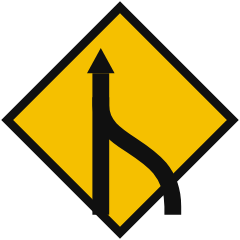
17. Why does the situation ahead of this sign deserve extra care from a motorcyclist?
Show answer
Answer C: Because a narrow machine is easy to overlook in a mirror or a blind spot
A motorcycle fills very little of a mirror and disappears easily into a blind spot, so the rider should adjust speed and lane position to stay visible where the streams come together.
-
18. When should you turn on your signal before a turn or a lane change?
Show answer
Answer C: Well before the maneuver, so other drivers have time to react
A signal is a warning to others, so it has to be given far enough ahead of the maneuver that drivers and pedestrians can adjust.
-
19. Where must the supervising driver sit while a Delaware Level 1 Learner's Permit holder drives?
Show answer
Answer A: Beside the permit holder in the front seat
The statute requires the supervising driver to be seated beside the permit holder in the front seat.
-
20. How does being tired change your total stopping distance?
Show answer
Answer A: It lengthens it, because you take longer to notice and react
Fatigue stretches perception and reaction time, and every extra fraction of a second is added distance before the brakes even begin to work.
-
21. An overhead lane signal shows a flashing yellow X above your lane. What does it mean?
Show answer
Answer D: The lane may be used only for a left turn
A flashing yellow X marks a lane that may be used only to make a left turn; a steady yellow X is the one that warns you to leave the lane.
-
22. What does Delaware law prohibit regarding electronic communication devices while driving?
Show answer
Answer D: Driving on any highway while using a handheld electronic communication device with the vehicle in motion
Delaware bans driving on a highway while using a handheld electronic communication device when the vehicle is in motion; hands-free use is excepted.
-
23. How recent must the two proofs of Delaware residency be when applying for a federally compliant license?
Show answer
Answer B: Postmarked or dated within 60 days
Delaware requires two separate residency documents postmarked within 60 days of the application.
-
24. How long is the revocation for a first refusal of a chemical test after a Delaware DUI arrest?
Show answer
Answer D: At least 1 year
A first refusal in a driving under the influence case brings a revocation of at least one year under the implied consent law.
-
25. You come up behind a group of cyclists riding two abreast on a narrow rural road. What should you do?
Show answer
Answer A: Wait for a clear stretch and pass them as one group
Passing a group as a single unit when the way ahead is clear is safer than several rushed passes, and cutting through the group leaves nobody any escape room.
-
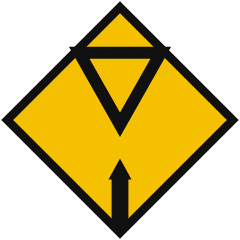
26. What will the driver have to do at the point this sign refers to?
Show answer
Answer C: Slow down and let conflicting traffic go first, stopping if that is what it takes
Further along, the driver has to let conflicting traffic and pedestrians go first, reducing speed and stopping whenever that is necessary to avoid interfering with them.
-
27. What is the earliest age at which Delaware issues a Class D license to a driver who is still a minor?
Show answer
Answer B: 17 years
A minor must be at least 17 and must have held the Level 1 Learner's Permit for at least 12 months before the Class D license is issued.
-
28. You drive onto a section where the top layer has been milled off and the surface is grooved. How will it feel?
Show answer
Answer C: The steering may wander, so hold the wheel firmly and slow down
Grooves cut into the pavement tug at the tires and make the steering feel restless. A firm grip and a lower speed keep the vehicle tracking straight.
-
29. What point value does the Delaware point schedule assign to speeding 1 to 9 miles per hour over the posted limit?
Show answer
Answer B: 2
The Delaware schedule assigns two points to speeding of 1 to 9 miles per hour over the limit, the same value used for an unlisted moving violation.
-
30. A pedestrian starts to cross against a Do Not Walk signal, right in front of you. What should you do?
Show answer
Answer D: Slow or stop and let the person reach safety
Even when a pedestrian is crossing unlawfully, a driver must take reasonable care to avoid hitting that person.
-
31. You have turned onto a street and see parked cars facing you and headlights coming toward you. What has probably happened?
Show answer
Answer C: You have turned the wrong way onto a one-way street
Vehicles parked facing you and headlights approaching in your lane are the classic signs of driving against the flow on a one-way street.
-
32. You are following another vehicle down a long, steep grade. What should you do about the gap?
Show answer
Answer D: Make it longer, because both of you need more room to stop
Everything takes longer to stop on a downgrade, including the vehicle ahead, so the gap that works on the flat is no longer enough.