
Delaware DMV Permit Practice Test 2
Test 2 of 10. Pick an answer for each question to see if it is right and why; your score appears at the end. You need 26 correct answers to pass, the same ratio as the real Delaware test.

- Questions32
- Correct to pass26
- Passing score81%
- Minimum age16 years
-
1. A sign shows a lane joining from the right with no merge required. What does that mean?
Show answer
Answer B: The joining traffic gets its own new lane, so nobody has to merge
An added lane means the roadway gains a lane at that point, so entering vehicles have somewhere to go without anyone changing lanes.
-
2. A loaded truck is coming up an entrance ramp as you approach in the right lane of the freeway. What is the most helpful action?
Show answer
Answer A: Adjust your speed to open a gap for it
A heavy vehicle accelerates slowly, so opening a gap or moving over costs you seconds and saves the truck driver from being forced to stop on the ramp.
-
3. In a work zone the temporary lane lines conflict with the old lines still visible on the pavement. Which do you follow?
Show answer
Answer C: The temporary markings, which show the current traffic pattern
Temporary markings define the traffic pattern in force, and the old lines are simply the layout that no longer applies.
-
4. Your right wheels have dropped onto a soft shoulder. Why should you not steer straight back onto the pavement?
Show answer
Answer A: The tires can catch the pavement edge and throw you across the road
A tire pressed against the edge of the pavement climbs it suddenly, and at speed that jolt can send the vehicle across the center line.
-
5. What must you be sure of before you pull out to pass on a two-lane road?
Show answer
Answer A: That the road ahead is clear far enough for the whole pass
You need enough clear road to pull out, pass and return before any oncoming vehicle arrives, and you must judge that distance before you start.
-
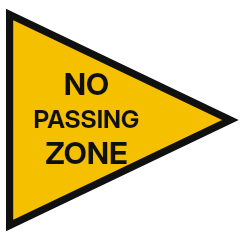
6. Why would a restriction like this one be applied to a stretch of road?
Show answer
Answer A: Because there is not enough visible road ahead to complete a pass safely
Limits on overtaking are set where a hill, a curve or an obstruction leaves too little sight distance for a driver to pull out, pass and return before meeting oncoming traffic.
-
7. Is dictating a message by voice a safe alternative to typing one?
Show answer
Answer C: No, it still takes attention from driving
Composing and checking a spoken message loads the mind and usually pulls the eyes to the screen anyway, so research finds it no safer than other phone use.
-
8. Apart from the charge added for each mile per hour over the limit, what base fine does Delaware set for a first speeding offense?
Show answer
Answer A: 20 dollars
The base fine is 20 dollars for a first offense and 25 dollars for each subsequent offense, before the per mile charge is added.
-
9. When should you move into the lane you need for a turn?
Show answer
Answer D: Well before the intersection, as soon as you know your route
Getting into the correct lane early lets other drivers read your intentions and keeps you from making a sudden lane change at the corner.
-
10. When does a Delaware applicant under 18 pay the Class D license fee?
Show answer
Answer C: At the time of the initial permit application
Delaware collects the Class D license fee at the time of the initial Level 1 Learner's Permit application rather than when the license is issued.
-
11. What does Delaware allow a Level 1 Learner's Permit holder to do with a mobile phone while driving?
Show answer
Answer A: Nothing; the permit bars device use while driving
The permit holder may not operate a vehicle while using a cellular telephone, text messager or similar device, and doing so counts as negligent operation.
-
12. The red brake warning light stays on after you release the parking brake. What should you do?
Show answer
Answer D: Stop safely and have the brakes checked before driving on
With the parking brake released, that light points to low fluid or a fault in one half of the braking system, which can leave you with very little braking.
-
13. Two vehicles reach a four-way stop at the same moment from adjacent roads. Who should go first?
Show answer
Answer A: The driver on the right
When two drivers stop at a four-way stop at the same time, the driver on the left yields to the driver on the right.
-
14. Within what period must medical expenses be incurred to be covered by Delaware personal injury protection?
Show answer
Answer B: 2 years from the date of the accident
Personal injury protection covers reasonable medical expenses incurred within two years of the accident, with a narrow extension for surgical or dental work.
-
15. At what speed does Delaware treat driving as reckless regardless of the driver's manner of operation?
Show answer
Answer D: 90 miles per hour or more
Delaware defines reckless driving to include driving at that speed or faster on a public roadway, quite apart from wilful or wanton disregard.
-
16. A motorcycle ahead of you is weaving slightly as it crosses a stretch of grooved pavement. What should you do?
Show answer
Answer D: Give the rider extra room until the surface improves
Grooves, metal plates and loose material affect a motorcycle far more than a car, so back off and let the rider deal with the surface.
-
17. What alcohol concentration makes driving illegal per se in Delaware for a driver aged 21 or older?
Show answer
Answer C: 0.08
Delaware law prohibits driving with an alcohol concentration of 0.08 or more.
-
18. Where should a rear-facing infant seat never be placed?
Show answer
Answer C: In a front seat with an active passenger air bag
A deploying front air bag strikes the back of a rear-facing seat with enormous force. Rear-facing seats belong in the back seat.
-
19. What age range applies to a Delaware Level 1 Learner's Permit?
Show answer
Answer D: At least 16 and less than 18
The Level 1 Learner's Permit is issued to applicants who are at least 16 years old and under 18.
-
20. What is the correct order of a pass on a two-lane road?
Show answer
Answer A: Check ahead and behind, signal left, move out, accelerate past, signal right and return
A pass begins with the decision that the road is clear and ends with a signaled return, and each step warns other drivers before the vehicle moves.
-
21. While driving on a Delaware Level 1 Learner's Permit, how many passengers besides the supervising driver may ride with the permit holder?
Show answer
Answer A: One
Throughout the first 12 months of the Level 1 permit only one passenger beyond the supervising driver is allowed, although immediate family members are exempt when the supervisor is present.
-
22. Low sun is shining onto the signal ahead and you cannot tell which light is lit. What should you do?
Show answer
Answer D: Slow down and be ready to stop until you can be sure
An unreadable signal has to be treated as one that may be red, so approach slowly enough to stop while you work out what it shows.
-
23. What late fee does Delaware add when a driver license is renewed after it has already expired?
Show answer
Answer B: 10 dollars
A renewal completed after the expiration date carries a 10 dollar late fee on top of the ordinary license fee.
-
24. You park on level ground in a lot. Where should the front wheels be pointing?
Show answer
Answer C: Straight ahead, so the car would not veer if it moved
On the level the wheels go straight so that the car stays in its own space, and so that a shunt from behind does not send it across a lane.
-
25. You are turning left out of a driveway onto a busy two-way street. What must you do?
Show answer
Answer D: Wait for a gap in both directions before you start to move
The turn crosses one direction of traffic and joins the other, so you need a gap in both before leaving the driveway rather than stopping across a lane.
-
26. A pedestrian using a white cane or walking with a guide dog starts to cross the street ahead of you. What must you do?
Show answer
Answer A: Yield and stay stopped until the person has finished crossing
A white cane or guide dog identifies a pedestrian who may not be able to see your vehicle, so you must yield and wait rather than maneuver around the person. The horn can confuse the pedestrian or the dog.
-
27. Why is it worth planning your route before a long drive?
Show answer
Answer B: So that you are not reading a map or a screen while the car is moving
A driver who knows the route is not navigating at the wheel, which is one of the commonest sources of distraction.
-
28. How many alcoholic drinks does it take to begin affecting driving ability?
Show answer
Answer C: Even one drink can affect it
A single drink can slow reactions and weaken judgment before you feel any change. Impairment starts long before a person feels drunk.
-
29. What is the Delaware statutory speed limit on a two-lane roadway where no other limit is posted?
Show answer
Answer C: 50 mph
Delaware law sets 50 mph on two-lane roadways.
-
30. Which of these makes you unpredictable to other drivers?
Show answer
Answer B: Changing lanes suddenly without signaling, to save a moment
An unsignalled, sudden lane change gives nobody time to react and is a common cause of sideswipe collisions.
-
31. How many points does Delaware assign to a moving violation that has no specific entry in the point schedule?
Show answer
Answer A: 2
Any moving violation drawn from Chapters 27, 41 or 42 of Title 21 that is not listed separately carries two points.
-
32. What does a booster seat do for a child?
Show answer
Answer B: It lifts the child so that the adult belt crosses hips and shoulder
A booster raises the child so the adult belt lies on the strong parts of the body instead of the neck and the abdomen.