
Delaware DMV Motorcycle Practice Test 42
- Questions25
- Correct to pass20
- Passing score80%
- Minimum age18 years
-
1. A rider chooses an open face helmet. What does that choice make necessary?
Show answer
Answer A: Separate goggles or a face shield, because the face is uncovered
An open face helmet gives no eye or face protection, so the rider must add goggles or a face shield that will not shatter and that seals against the wind.
-
2. Why is a sign reading BRIDGE ICES BEFORE ROAD worth heeding even when the road itself is merely wet?
Show answer
Answer C: Cold air passes under a bridge as well as over it
A bridge deck loses heat from below as well as above, so it can be frozen while the road on either side of it is only wet.
-
3. Why does a rider on an unfaired motorcycle tire faster on a long highway ride than a driver would?
Show answer
Answer A: Constant wind pressure and noise drain energy hour after hour
Fighting wind pressure and enduring wind noise for hours is physically tiring, which is why wind protection and regular breaks matter on long rides.
-
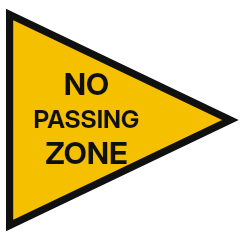
4. Where does the restriction that starts at this sign come to an end?
Show answer
Answer D: Where the centerline markings show that overtaking is allowed again
The sign marks the start of the restricted section, and the centerline markings along the road show how far it runs and where overtaking becomes lawful again.
-
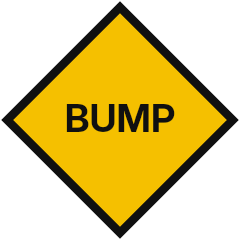
5. How should a driver respond to this sign?
Show answer
Answer C: Slow down before reaching the rough spot and cross it at a steady, low speed
Losing speed before a sharp rise in the pavement keeps the vehicle settled, while braking or accelerating on top of it unsettles the suspension and costs grip.
-
6. What does a steady yellow traffic light tell the driver facing it?
Show answer
Answer A: The green movement is ending and a red indication is about to appear
A steady yellow warns that the related green movement is being terminated and that red will follow, so you should stop if you can do so safely.
-
7. A reduced speed limit posted with this sign and a plaque giving hours is in force

Show answer
Answer C: during the hours shown on the plaque, or while the beacon is flashing
A school speed limit applies during the periods stated on the plaque or while the attached beacon flashes, and the regular limit governs outside those periods.
-
8. Why should a rider pull in the clutch at the first sign that the engine is seizing?
Show answer
Answer B: So a locking engine cannot lock the rear wheel through the drive train
A seizing engine can lock up, and with the clutch engaged that would lock the rear wheel, so disconnecting the drive keeps the wheel rolling while you coast off the road.
-
9. You turn from asphalt onto a loose gravel road. What should you do about your speed?
Show answer
Answer D: Lower it, since grip is reduced and stopping takes longer
Loose gravel gives far less grip than pavement, so speed must come down for both steering and stopping.
-
10. What is a microsleep?
Show answer
Answer D: A few seconds of sleep, sometimes with the eyes open
A microsleep is an involuntary lapse of a few seconds during which the driver is asleep and the vehicle travels blind, often without the driver knowing.
-
11. A bee gets inside your jacket while you are riding. What is the recommended action?
Show answer
Answer B: Pull off the road and stop before you try to deal with the insect
Being stung hurts, but losing control while swatting hurts much more, so ride to a safe place, stop and then deal with the insect.
-
12. You are leaving a freeway on an exit ramp posted with an advisory speed of 25 mph. Where should you slow to that speed?
Show answer
Answer A: In the deceleration lane, before you reach the curve of the ramp
Slowing belongs in the deceleration lane so you arrive at the curve already at the advisory speed and do not hold up traffic still in the through lanes.
-
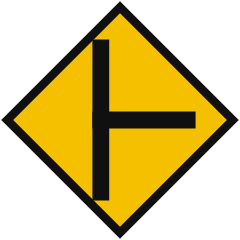
13. What condition does this sign warn a driver about?
Show answer
Answer B: Another road joins the road being traveled, from one side
It announces a side road entering the main roadway, so the driver should expect vehicles waiting to pull out and other vehicles slowing to turn in.
-
14. A line of short dashes set closer together than an ordinary lane line runs beside your lane where a ramp leaves the highway. What does a dotted line of that kind convey?
Show answer
Answer A: A warning that the lane is about to change function
Dotted lines give guidance or warning about a downstream change, such as a lane that becomes an exit only lane or a lane line carried across an intersection.
-
15. Where does part of each 100 dollar Delaware handheld device penalty go?
Show answer
Answer B: To the Volunteer Ambulance Company Fund
Twenty dollars out of each 100 dollar penalty is directed to the Volunteer Ambulance Company Fund.
-
16. A yellow diamond shows an arrow bent into a series of reversing turns. What does it warn about?
Show answer
Answer A: Three or more changes of direction close together
The winding road sign replaces a string of separate curve signs where several bends follow one another with only short straights between them.
-
17. Two vehicles meet on a steep, narrow mountain road with no room to pass. Which driver should back up?
Show answer
Answer C: The driver heading downhill, who has more control while reversing
On a narrow mountain road the vehicle facing downhill yields, because backing uphill gives better control than reversing down a grade.
-
18. How does riding in a formation change your responsibility for your own space cushion?
Show answer
Answer C: It does not change it, because each rider still manages their own space and decisions
A formation organizes the group, but every rider remains responsible for their own following distance, escape paths and riding decisions.
-
19. Why do drivers so often misjudge how fast an approaching motorcycle is traveling?
Show answer
Answer C: A narrow vehicle seems to grow slowly, so it appears further away
A small frontal area changes size slowly as it approaches, so drivers read a motorcycle as further away and slower than it really is. Never assume a waiting driver has judged your speed correctly.
-
20. The neutral light is on, but you are not sure the transmission is really out of gear. How can you confirm it?
Show answer
Answer B: Release the clutch and rock the motorcycle to see whether it rolls freely
A machine that rolls without resistance while the clutch is released is genuinely in neutral, which a burnt out or faulty neutral switch cannot tell you.
-
21. You are driving on a road covered with a layer of wet fallen leaves. What should you expect?
Show answer
Answer B: As little grip as on ice, plus hidden markings and hidden holes
Wet leaves are as slippery as ice and they hide the lane lines and any potholes underneath, so slow well before curves and stops.
-
22. An oncoming driver flashes their headlights while you are waiting to turn left. What should you do?
Show answer
Answer D: Judge the situation yourself, since the flash may mean something else
A flash is not a legal signal and may mean many things, so the decision to turn stays yours and must be based on what you can see.
-
23. How much space should the leader of a group keep behind the vehicle ahead of the group?
Show answer
Answer D: At least the normal following distance a rider would keep when riding alone
Riding in a group does not shorten the space a motorcycle needs to stop, so the leader keeps the same cushion any rider would keep alone.
-
24. A large panel mounted on a trailer at the roadside displays a flashing arrow pointing left. What does it tell you?
Show answer
Answer B: Move into the lane to your left
An arrow panel directs traffic out of a closed lane, so the arrow shows the direction you must move rather than the shape of the road ahead.
-
25. How long is a Delaware motorcycle instruction permit valid?
Show answer
Answer A: Six months, with one extension available for a 5 dollar fee
The permit runs for six months and may be extended once for a 5 dollar fee.