
Delaware DMV Motorcycle Practice Test 41
- Questions25
- Correct to pass20
- Passing score80%
- Minimum age18 years
-
1. A driver is following you far too closely and you have a turn coming up. How should you slow down for it?
Show answer
Answer B: Signal early and slow gradually well before the turn
Early signals and gentle braking give a tailgater the time and distance they have failed to leave for themselves.
-
2. How can you check that you are keeping a safe following distance?
Show answer
Answer A: Count at least three seconds between the vehicle ahead passing a fixed object and your reaching it
Pick a fixed roadside object, start counting when the vehicle ahead passes it and make sure at least three seconds elapse before you reach it, adding more time in poor conditions.
-
3. A bicyclist is riding in the middle of a narrow travel lane ahead of you. What is the correct response?
Show answer
Answer D: Slow down and wait until you can pass with wide clearance, changing lanes if needed
A bicyclist has the same right to use the lane as a driver, and a narrow lane may not leave safe passing room, so wait for a gap that lets you move over and pass with a wide margin.
-
4. A sign on a divided highway reads Keep Right Except to Pass. What does it require of you?
Show answer
Answer A: Use the left lane only to overtake, then return to a lane on the right
The left lane on such a highway is reserved for overtaking, so a driver who has finished a pass must move back to the right.
-
5. You must slow down in a curve but there is no room to straighten the motorcycle. What should you do?
Show answer
Answer A: Brake gently at first and reduce the lean angle as your speed comes down
Braking and turning compete for the same traction, so brake pressure has to stay light while lean angle is high and can grow as the machine comes upright.
-
6. How far forward should a rider sit on the seat?
Show answer
Answer D: Far enough forward that the arms are slightly bent on the grips
Slightly bent arms let the rider steer with the handlebars instead of using the arms to prop up the upper body.
-
7. May you exceed the posted speed limit in order to complete a pass?
Show answer
Answer C: No, the posted limit applies while you are passing too
The limit does not lift for passing; if you cannot complete the pass within it, there is not enough room and you should stay back.
-
8. You cannot avoid an obstacle lying in the road. At what angle should you try to cross it?
Show answer
Answer D: As close to 90 degrees as possible
Meeting the obstacle squarely keeps the front wheel from being deflected sideways as it climbs over the edge.
-
9. A driver holds a steady highway speed into the section this sign warns about. What is the most likely result?
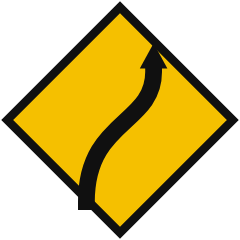
Show answer
Answer B: The vehicle runs wide toward the outside and can cross into another lane or leave the pavement
Holding speed into a change of alignment asks the tires for more side grip than they can supply, so the vehicle runs wide and the driver is left with less room to correct.
-
10. Why should a rider reduce speed at night even on a familiar road?
Show answer
Answer C: So the stopping distance stays inside the distance the headlight lights up
At night you can only react to what the headlight shows, so keep your speed low enough that you can stop within the lit distance ahead.
-
11. How many questions are on the Delaware motorcycle knowledge test?
Show answer
Answer C: 25
The Delaware motorcycle knowledge test has 25 questions taken from the Delaware Motorcycle Operator Manual.
-
12. Your vehicle breaks down on a busy highway. What is the safest course of action?
Show answer
Answer D: Get it as far off the roadway as possible, switch on the hazard lights and keep clear of the traffic lanes
A vehicle left in or beside a travel lane is a hazard, so move it well off the road, make it conspicuous with hazard lights and keep yourself away from passing traffic.
-
13. Which helmet style gives the rider the most coverage?
Show answer
Answer C: A full face helmet
A full face helmet covers the chin and jaw as well as the skull, protecting the area that open styles leave exposed.
-
14. How does weight transfer during braking change what each brake can do?
Show answer
Answer A: Weight moves forward, so the front tire grips harder and the rear grips less
Deceleration pitches the machine forward onto the front wheel, which is why the front brake supplies most of the stopping power and the rear locks easily.
-
15. Why do experienced riders squeeze the clutch lever while starting the engine, even with the neutral light showing?
Show answer
Answer A: In case a gear is engaged, so the motorcycle cannot lurch forward
A neutral light can be wrong, and a disengaged clutch means the machine stays still even if the transmission is actually in gear.
-
16. What is the function of a regulatory sign?
Show answer
Answer A: To inform road users of traffic laws or regulations that apply at that location
Regulatory signs state requirements that carry the force of law where they are posted, so disregarding one is a violation rather than a lapse of judgment.
-
17. How long is the revocation for a first Delaware DUI where the alcohol concentration was at least 0.15 but less than 0.20?
Show answer
Answer B: 18 months
That concentration band lengthens the first offense revocation from twelve to eighteen months.
-
18. A sign with a green background and a white legend normally provides
Show answer
Answer A: directions, distances and destinations
Green is the background color of the guide sign series, which names routes and destinations and gives the distance to them.
-
19. You enter a work zone where the top layer of pavement has been milled off, leaving a grooved surface. How should you ride?
Show answer
Answer B: Hold a relaxed grip and steady speed, and expect the tires to wander
Milled or grooved pavement makes the tires follow the ridges and the motorcycle feel unsettled, so relax on the bars, keep a constant speed and ride straight through.
-
20. Should a rider change lanes while passing through an intersection?
Show answer
Answer A: No, the lane change should be completed before or after the intersection
Drivers entering and turning at an intersection are watching lanes rather than a machine moving between them, and lane markings are usually broken there.
-
21. Why is repeatedly changing lanes to work through heavy traffic a poor idea?
Show answer
Answer A: It raises the crash risk and saves almost no time
Each lane change adds a conflict with another vehicle, and in congestion the lanes move at similar average speeds, so the gain is negligible.
-
22. How can you keep space at the sides of your vehicle in heavy traffic?
Show answer
Answer D: Drive in the gaps between the other vehicles rather than beside them
Travelling in the open spaces rather than alongside others keeps a way out open on at least one side.
-
23. Rain is falling and the outside temperature reads close to 32 degrees Fahrenheit. Why is that dangerous?
Show answer
Answer A: The rain can freeze on contact and glaze the road with ice
Near freezing, rain landing on cold pavement can turn to a glaze of ice almost at once, so a road that looks merely wet may have no grip at all.
-
24. What should a rider remember about convex mirrors?
Show answer
Answer B: They show a wider view, but vehicles look farther away and slower than they are
The curved glass fits more of the scene into the mirror, and the price of that extra width is a distorted sense of distance and closing speed.
-
25. You are approaching a yield sign on a ramp that joins a busy street. What does the sign require?
Show answer
Answer A: Slow down, be ready to stop, and let the other traffic go first
A yield sign means you must slow, be prepared to stop and give way to traffic on the road you are entering; a full stop is required only when traffic makes it necessary.