
Delaware DMV Motorcycle Practice Test 26
- Questions25
- Correct to pass20
- Passing score80%
- Minimum age18 years
-
1. Another driver cuts you off and you feel your temper rising. What should you do?
Show answer
Answer A: Take a breath, drop back and let it go, because the whole trip matters more
Retaliation turns a moment of bad driving into a crash, and dropping back costs you only a few seconds.
-
2. What must a motorcycle be equipped with before it can safely carry a passenger?
Show answer
Answer B: A seat large enough for two people and a set of passenger footrests
A passenger needs a seat with room for both people without crowding and firm footrests to brace against.
-
3. You reach an intersection showing a steady red light, and a stop line is painted across your lane. Where must you bring the vehicle to a complete stop?
Show answer
Answer C: Before the stop line
A steady red requires a complete stop before the marked stop line. Where there is no stop line you stop before the crosswalk, and where there is neither, before entering the intersection.
-
4. What should you avoid when a hostile driver pulls alongside you?
Show answer
Answer A: Making eye contact, or answering the gestures in any way at all
Any response, including a look, encourages an aggressive driver, so give none and let the vehicle go.
-
5. You must stop for a train at a highway-rail crossing. Where should you stop?
Show answer
Answer B: Behind the stop line, gate or signal and well clear of the nearest rail
Stop behind the stop line, gate or flashing-light signal and well clear of the nearest rail, because a train overhangs its track by several feet on each side.
-
6. The engine begins to lose power, makes a loud noise and starts to seize. What should the rider do?
Show answer
Answer C: Pull in the clutch at once and coast off the road to a safe place
A seizing engine can lock the rear wheel, and pulling in the clutch separates it from the wheel so the motorcycle keeps rolling under control.
-
7. How does eating a large meal before drinking affect impairment?
Show answer
Answer D: It slows absorption but the alcohol still reaches the blood and impairs you
Food delays how quickly alcohol enters the bloodstream, which can make the peak arrive later, but all of the alcohol is eventually absorbed.
-
8. The school bus stop ahead sign is installed where
Show answer
Answer C: a school bus stop cannot be seen from far enough away by approaching drivers
This school warning sign is used in advance of a bus stop that lacks adequate sight distance and cannot be relocated, so drivers are warned before the stopped bus comes into view.
-
9. You are stopped facing uphill on a steep grade and need to pull away. What is the recommended technique?
Show answer
Answer D: Hold with the rear brake, ease the clutch into the friction zone, then release
The rear brake keeps the motorcycle from rolling backward while the clutch takes up the drive, and it is released as the throttle is opened.
-
10. When is a driver or rider most likely to need hand and arm signals instead of the vehicle turn signal lamps?
Show answer
Answer D: When the lamps have failed or cannot be seen because of glare or a load
Hand and arm signals replace or reinforce the lamps whenever the lamps do not work or cannot be seen clearly by other road users.
-
11. On a street with parking along the curb, the shared lane marking is painted well out from the curb face. What does that placement tell a bicyclist?
Show answer
Answer C: To ride clear of the doors of parked cars
The marking is set at least eleven feet from the curb where parking is allowed so that riders are guided outside the reach of an opening door.
-
12. A yellow diamond in which one line joins another at an angle warns that
Show answer
Answer B: traffic from another roadway will merge into the driver's lane ahead
The merge sign warns that another traffic stream will join the same lane ahead, so drivers on both roadways must adjust speed and spacing.
-
13. A pedestrian is waiting to cross ahead of you and you have slowed down. What helps most?
Show answer
Answer D: Making eye contact, so that you both know you have seen each other
Eye contact confirms that you have seen each other; waving someone across can send them into the path of another vehicle.
-
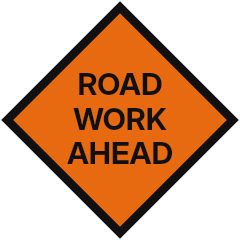
14. How should speed and following distance be adjusted beyond this sign?
Show answer
Answer D: Cut speed and leave a longer gap, because traffic can stop without warning
Traffic in these areas stops and starts unexpectedly and there is little room to steer around a problem, so extra space is what prevents a rear-end collision.
-
15. You are pulling out of a farm entrance onto a rural highway. What is your obligation?
Show answer
Answer C: Yield to every vehicle already on the highway before you enter the roadway
A driver entering a highway from a private road or driveway yields to every vehicle already on the highway.
-
16. A friend who has been drinking insists on driving home. What is the right thing to do?
Show answer
Answer B: Take the keys and arrange a sober ride, even if the friend objects
An impaired driver is dangerous on any street at any speed, and coffee does not lower blood alcohol. Keeping the keys and finding another way home is the only safe choice.
-
17. An orange sign reading END ROAD WORK is posted beside the highway. What does it mark?
Show answer
Answer C: The point where the work zone restrictions stop
The sign is installed at the downstream end of the temporary traffic control zone to tell drivers that normal conditions apply again.
-
18. Your motorcycle has a grab rail behind the passenger seat. What should the passenger know about using it?
Show answer
Answer C: It is fine to hold, but they must still brace against acceleration
A rail behind the passenger gives a secure grip but does nothing to stop them sliding backward, so they still need to expect the machine to pull away.
-
19. Why do watering eyes matter so much to a rider?
Show answer
Answer D: Blurred vision delays the moment you see and react to a hazard
Wind makes unprotected eyes water, and even a brief loss of clear vision at road speed costs you the distance you need to react.
-
20. How should you follow a school bus in traffic?
Show answer
Answer A: Far enough back to see its lights and stop in time
A school bus stops often and with little warning, so a longer following distance gives you time to see the lights come on and stop clear of it.
-
21. What does a tire with worn tread do on a wet road?
Show answer
Answer B: It loses grip and it hydroplanes at a lower speed than a good tire
Tread grooves carry water away from the contact patch, and a worn tire cannot do that, so it floats on the water sooner.
-
22. A sign at the curb reads Tow-Away Zone. What does it mean for you?
Show answer
Answer C: That a vehicle left there can be removed at the owner's expense
In a tow-away zone the vehicle can be removed immediately and the owner pays the towing and storage charges to get it back.
-
23. Which rough check suggests that a helmet is a novelty shell rather than a certified helmet?
Show answer
Answer C: It weighs about a pound, far less than a certified helmet
A certified helmet weighs roughly three pounds because of its shell and thick liner, while a novelty shell is very light. Weight is only a clue, and the certification label is the real check.
-
24. An arrow panel in a work zone shows four flashing lamps in caution mode instead of an arrow. What does that display mean?
Show answer
Answer A: Warning only, so pass the work area with caution in your current lane
Caution mode gives a general warning without directing a lane change, so drivers stay alert and pass the activity with care.
-
25. The trapezoid sign shape is associated with
Show answer
Answer C: recreational and cultural interest area signing
The trapezoid is used for recreational and cultural interest area guide signs and for national forest route markers.