
Delaware DMV Permit Practice Test 36
- Questions32
- Correct to pass26
- Passing score81%
- Minimum age16 years
-
1. Which steering method gives the most control when you must turn the wheel a long way at low speed?
Show answer
Answer C: Hand over hand, feeding the wheel from one hand to the other
Hand over hand keeps both hands on the wheel through a large turn, so you never lose the ability to correct quickly.
-
2. What does a traction control system do?
Show answer
Answer A: It limits wheel spin when you accelerate
Traction control cuts power or brakes a spinning wheel so the tires can grip when you pull away or accelerate on a slippery surface.
-
3. You correct a rear wheel skid and the back of the vehicle swings the other way. Why?
Show answer
Answer D: You steered too far, so be ready to correct back the other way
Over correcting sends the tail past straight and starts a second skid the opposite way. Steer smoothly and be ready to unwind the correction.
-
4. You are driving on the through road of a T-intersection and want to turn left into the side road. Oncoming traffic is approaching on the through road. What must you do?
Show answer
Answer C: Yield to the oncoming traffic before you turn
The vehicle waiting in the stem of the T yields to both of you, but you still owe the right of way to oncoming through traffic before turning across it.
-
5. A driver who is passing you cannot complete the pass because a vehicle is coming. What should you do?
Show answer
Answer C: Ease off the accelerator and make room for them to drop back in
The only place for the passing vehicle to go is the gap behind you, and easing off opens that gap immediately.
-
6. How long must a Delaware Level 1 Learner's Permit be held before a Class D operator's license may be issued?
Show answer
Answer C: 12 months
Delaware requires 12 months of valid permit driving before the Class D license can be issued.
-
7. A dust storm is blowing across the highway ahead of you. What is the recommended response?
Show answer
Answer B: Leave the road if you can, park well clear and take your foot off the brake
Get well off the pavement, switch the lights off and keep your foot off the brake, so drivers still on the road do not follow your tail lights off the highway.
-
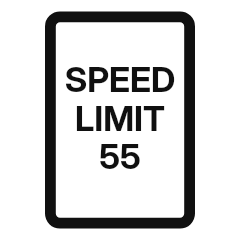
8. A driver passes this sign on an open road. Over what stretch does the figure it sets stay in force?
Show answer
Answer A: From the sign onward, in every lane, until another sign sets a different figure
The figure governs the road from the sign onward and binds every lane, and it stays in force until a later sign sets a different one.
-
9. You are driving in fog so thick that you can barely see the vehicle ahead. Which pavement marking is the best guide for staying in your lane?
Show answer
Answer A: The white edge line on the right side of the road
The right edge line keeps you positioned away from oncoming traffic and is easy to follow at low speed. Following tail lights closely tempts you to drive faster than you can see.
-
10. You are traveling at 55 mph on a rural road and come up behind a horse-drawn buggy. What is the main danger?
Show answer
Answer D: You close on it very quickly because it moves at walking pace
A buggy travels only a few miles an hour, so the gap closes far faster than drivers expect and there is very little time to brake once you see it.
-
11. Delaware requires personal injury protection coverage with what minimum limits?
Show answer
Answer A: 15,000 dollars per person and 30,000 dollars per accident
Delaware policies must pay medical expenses and lost wages up to at least 15,000 dollars for one person and 30,000 dollars for all persons injured in one accident.
-
12. You are stopped at a red light ready to turn right when a person pushing a stroller steps into the crosswalk. What should you do?
Show answer
Answer A: Stay stopped until they have crossed your path
A turn on red gives way to every pedestrian in the crosswalk, and someone pushing a stroller has even less room to react.
-
13. You are driving on a rural road with no sidewalk. Where should you expect to meet pedestrians?
Show answer
Answer A: Walking toward you on your side of the road
Where there is no sidewalk, pedestrians are taught to walk facing traffic, so they appear on your side of the road coming toward you.
-
14. How does alcohol change the time a driver needs to respond to a hazard?
Show answer
Answer A: It slows it, so stopping takes longer
Alcohol is a depressant that lengthens the time between seeing a hazard and acting on it, which adds directly to the distance needed to stop.
-
15. The word SCHOOL is painted in large letters across the roadway. What is it doing?
Show answer
Answer D: Backing up the signs marking a school zone
Word markings on the pavement reinforce a message that is already signed, and a driver looking at the road ahead cannot miss them.
-
16. How early may a Delaware driver license be renewed before the expiration date?
Show answer
Answer C: 180 days
The Division of Motor Vehicles opens the renewal window 180 days before the license expires; the commercial license window opens only 30 days ahead.
-
17. A preferential lane sign reads HOV 2+ and lists the hours it applies. During those hours, which vehicles may use the lane?
Show answer
Answer A: Vehicles carrying at least two people, counting the driver
The number on an HOV sign is the minimum number of occupants, driver included, that a vehicle must carry to use the lane while the restriction is in effect.
-
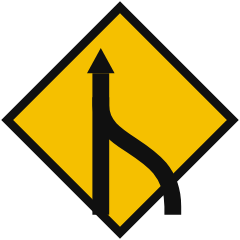
18. Why does the situation ahead of this sign deserve extra care from a motorcyclist?
Show answer
Answer C: Because a narrow machine is easy to overlook in a mirror or a blind spot
A motorcycle fills very little of a mirror and disappears easily into a blind spot, so the rider should adjust speed and lane position to stay visible where the streams come together.
-
19. How much more energy must your brakes absorb if you double your speed?
Show answer
Answer D: About four times as much, since energy rises with the square of speed
Kinetic energy grows with the square of speed, so twice the speed means about four times the energy and a far longer braking distance.
-
20. You have parked but your car sits across the line into the next space. What should you do?
Show answer
Answer B: Pull out and park again fully inside one space
A car over the line takes a space away from someone else and leaves too little room for the doors of the vehicles beside it.
-
21. Lights set into the pavement along both edges of a crosswalk start to flash yellow as you approach. What do they tell you?
Show answer
Answer D: Someone is crossing and has to be given way
In-roadway warning lights flash only when a pedestrian activates the crossing, so a flashing pattern means somebody is in or entering the crosswalk.
-
22. Your light is green but the traffic beyond the intersection is stopped and there is no room on the far side. What should you do?
Show answer
Answer A: Wait behind the line until you can clear the far side
Entering an intersection you cannot clear blocks the cross traffic when their signal turns green, so you wait behind the line.
-
23. Two left-turn lanes are available and you must turn right again a short distance after the turn. Which of the two should you use?
Show answer
Answer D: The right one, so you finish nearer the right side of the new street
Each turn lane feeds the matching lane of the new street, so choosing the right-hand of the two left-turn lanes leaves you closer to the side you will need.
-
24. Traffic is heavy and a truck is stopped in the lane on your right. How do you keep an out?
Show answer
Answer B: Keep space open ahead of you and avoid being boxed in on both sides at once
Being hemmed in on both sides with no gap ahead removes every option, so keep at least one direction open.
-
25. Why should you avoid swinging wide to the left before making a right turn in a car?
Show answer
Answer A: Another driver may think you are turning left and try to pass on your right
Swinging left first misleads other road users about your intention and invites someone to move up on your right, exactly where you are about to go.
-
26. Smoke from a nearby fire is drifting across the highway. What should you do?
Show answer
Answer C: Slow down, use low beams, and close the windows and vents
Smoke cuts visibility like fog and can make your eyes water. Low beams, a much lower speed and closed vents protect both your view and the air in the car.
-
27. You are circulating in a roundabout and a vehicle is waiting to enter ahead of you. What should you do?
Show answer
Answer D: Keep going, because circulating traffic does not stop for entering vehicles
Stopping in the circle to be polite surprises the drivers behind you and defeats the design; entering traffic is the side that waits.
-
28. A bicyclist in the bike lane ahead of you signals and starts to move left toward the turn lane. What should you do?
Show answer
Answer A: Slow down and let the rider move across
A bicyclist who needs to leave the bike lane to turn left is changing lanes like any driver, and following traffic should make room.
-
29. What is the correct order of a pass on a two-lane road?
Show answer
Answer A: Check ahead and behind, signal left, move out, accelerate past, signal right and return
A pass begins with the decision that the road is clear and ends with a signaled return, and each step warns other drivers before the vehicle moves.
-
30. When is a child ready to use a vehicle seat belt without a booster seat?
Show answer
Answer A: When the lap belt lies across the upper thighs and the shoulder belt crosses the chest
Belt fit, not age, decides readiness. Until the child is tall enough for the lap belt to sit on the thighs and the shoulder belt on the chest, a booster is needed.
-
31. You are stopped at a red light waiting to turn right where the turn is allowed. Besides traffic from the left, what must you check?
Show answer
Answer D: Both crosswalks, and anyone approaching along your right side
A right turn on red crosses the crosswalk in front of you and enters the one on the cross street, and cyclists often approach along your right.
-
32. You reach a one-lane bridge and a vehicle is already partway across it coming toward you. What should you do?
Show answer
Answer D: Stop before the bridge and let it come through
A vehicle already on a one-lane bridge has the right of way, and the driver who has not yet entered waits at the approach.