
Delaware DMV Permit Practice Test 35
- Questions32
- Correct to pass26
- Passing score81%
- Minimum age16 years
-
1. Where among these is parking specifically prohibited?
Show answer
Answer A: On a bridge, in a tunnel or on railroad tracks
Bridges and tunnels have no safe refuge and cannot be widened, and a vehicle left on railroad tracks cannot be avoided by an approaching train.
-
2. You reach an uncontrolled intersection at the same moment as a vehicle approaching from your left. What should you do?
Show answer
Answer A: Proceed, but only once you see that driver slowing
You have the right of way over the vehicle on your left, but a right of way is something the other driver has to give, so confirm it before you commit.
-
3. A yellow diamond reading DIP warns a driver about
Show answer
Answer A: a short, sharp depression in the road surface
A dip is an abrupt low point that can jolt a vehicle or scrape its underside, so speed should be reduced before reaching it.
-
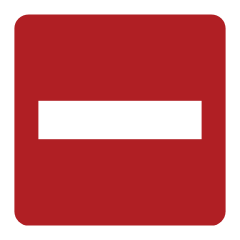
4. At which location is this sign normally installed?
Show answer
Answer D: Facing traffic that could turn into a one-way roadway or ramp against the flow
It is posted where a driver could otherwise enter a ramp or a one-way roadway from the wrong end, so it faces exactly the traffic that has to be kept out.
-
5. You are hosting a party and a guest who has been drinking wants to drive home. What should you do?
Show answer
Answer D: Stop serving and arrange a ride or a bed
Only time removes alcohol, so a host who wants to prevent a crash has to remove the driving, not try to speed up sobering that cannot be sped up.
-
6. An overhead lane-use control signal shows a steady red X above the lane you are traveling in. What does it require?
Show answer
Answer D: Leave that lane, because it is closed to you
A steady red X means road users are not permitted to use the lane beneath it, so you must move into a lane that is open.
-
7. What happens when tires are driven underinflated for a long time?
Show answer
Answer D: They wear at the edges, they run hot and they are more likely to fail
An underinflated tire flexes too much, which wears the shoulders and builds up heat that can destroy the tire.
-
8. The car ahead drifts across the lane line and back again several times. What should you do?
Show answer
Answer C: Assume that the driver is distracted or impaired, and keep well back
Drifting is a classic sign of a distracted, drowsy or impaired driver, and distance is your protection from all three.
-
9. On a Delaware road with fewer than four lanes, what does the move over law require as a driver passes a stopped emergency vehicle?
Show answer
Answer B: Proceed with caution at a reduced and safe speed
Where no separate lane is available, the driver must proceed with caution and reduce speed to a safe level rather than stopping or changing course.
-
10. At a stop sign with a painted stop line and a crosswalk, where must you stop?
Show answer
Answer D: At the stop line, before it and before the crosswalk
You stop at the stop line first, and only if there is no stop line do you stop before the crosswalk, and only if there is neither do you stop before entering the intersection.
-
11. How can you tell a tire has reached its wear limit without measuring it?
Show answer
Answer C: The wear bars across the grooves become level with the tread
Molded bars sit at the bottom of the grooves. Once the surrounding tread has worn down to them, the tire has reached the end of its safe life.
-
12. A white arrow painted in your lane points only to the right, and a sign above the lane shows the same movement. What must you do?
Show answer
Answer C: Turn right from that lane
Pavement arrows used with lane-use signs are regulatory, so a driver occupying that lane must make the movement shown.
-
13. How many points does Delaware assess for disregarding a stop sign or a red light?
Show answer
Answer C: 3
Disregarding a stop sign or a traffic signal is assessed at three points, more than an ordinary moving violation but less than reckless driving.
-
14. How does braking distance change if you double your speed?
Show answer
Answer D: It grows much more than twice as long
Braking distance increases with the square of speed, so doubling speed roughly quadruples the distance needed to stop.
-
15. A flagger turns the paddle to the orange face reading SLOW. What does that tell approaching drivers?
Show answer
Answer D: Reduce speed and continue through the work area with care
The SLOW face keeps traffic moving at a reduced speed while workers or equipment are close to the travel lanes.
-
16. What is the first thing to do once your disabled vehicle is stopped on the shoulder?
Show answer
Answer A: Switch on the hazard warning lights so other drivers can see the vehicle
Hazard lights are the fastest way to make a stopped vehicle visible, and everything else can follow once traffic has been warned.
-
17. How many points in a year will cost a Delaware driver an ignition interlock license?
Show answer
Answer B: More than 5
The interlock license is revoked if the holder accumulates more than five points in a year or otherwise breaks the program rules.
-
18. You are approaching the crest of a hill and cannot see the road beyond it. What should you do?
Show answer
Answer C: Slow down and keep well to the right
Beyond a blind crest there may be a stopped vehicle, a cyclist or an oncoming driver crossing the center line, so reduce speed and hold your own side.
-
19. What can a loose or doubled up floor mat on the driver side cause?
Show answer
Answer A: It can slide forward and trap the accelerator pedal down
An unsecured mat, or a second mat laid over the first, can slip forward and hold the accelerator open. Use the mat clips and never stack mats.
-
20. Why are motorcycles so often missed by other drivers?
Show answer
Answer C: Their narrow shape is easily hidden in traffic
A motorcycle presents a narrow outline that disappears behind pillars, mirrors and other vehicles, and it is harder to judge its speed and distance.
-
21. What is the basic rule for entering a roundabout?
Show answer
Answer B: Traffic already circulating goes first, and you wait for a gap
Entering traffic yields to vehicles already going around the circle, which is what keeps a roundabout moving instead of locking up.
-
22. At an intersection the signal flashes red toward you and flashes yellow toward the cross street. Who must yield?
Show answer
Answer D: You must, because the flashing red faces your road
A flashing red means stop and yield like a stop sign, while a flashing yellow lets the other road proceed with caution.
-
23. You enter a corner faster than the turn can be taken. What is the most likely result?
Show answer
Answer A: The vehicle runs wide and may cross into another lane
Excess speed uses up the available grip, so the vehicle follows a wider arc than intended and drifts out of its lane.
-
24. How should a lap and shoulder belt be positioned?
Show answer
Answer A: Lap belt low across the hips and shoulder belt across the chest and collarbone
The lap belt must bear against the strong pelvic bones rather than soft organs, and the shoulder belt must cross the rib cage and collarbone so crash forces spread over the skeleton.
-
25. You have parked a manual transmission car facing downhill. Which gear should you leave it in?
Show answer
Answer D: Reverse, along with the parking brake set firmly
Facing downhill the car would roll forward, so reverse gear opposes that movement while the parking brake and turned wheels back it up.
-
26. How does going a long time without sleep compare with drinking?
Show answer
Answer A: It can impair a driver in much the same way
Long periods awake produce slow reactions, poor judgment and lapses of attention that resemble the effects of alcohol, which is why fatigue counts as impairment.
-
27. Why does a dirty windshield matter much more at night than during the day?
Show answer
Answer C: Dust and streaks scatter oncoming light and increase glare
Film and streaks on the glass spread every oncoming headlight into a star of glare, so clean the inside as well as the outside before a night trip.
-
28. The signal ahead has a sign prohibiting left turns, and your route needs a left. What should you do?
Show answer
Answer D: Go straight on and find a legal place to turn and come back
A turn prohibition applies to every driver, so you continue through and reach your route by another legal turn.
-
29. You want to turn right at a steady red light and no sign prohibits the turn. What is required?
Show answer
Answer B: Come to a complete stop, then yield to traffic and pedestrians before turning
A right turn on a steady red is permitted only after a complete stop and only after yielding to cross traffic and to pedestrians, and a posted sign can prohibit it entirely.
-
30. Small green signs with white numerals posted at regular intervals along a highway are used to
Show answer
Answer B: show distance along the route and give a reference point for reporting a location
Reference location signs, commonly called mileposts, carry white numerals on green and let a driver describe exactly where a breakdown or crash has occurred.
-
31. You are involved in a collision, even a minor one. What is your first legal duty?
Show answer
Answer A: Stop at or near the scene without blocking traffic more than necessary
Every driver involved in a crash must stop at the scene, and leaving before meeting that duty is a serious offense. Move the vehicles only as far as needed to clear the traffic lanes.
-
32. In plain words, what is oversteer?
Show answer
Answer C: The rear of the vehicle slides out and the car turns too sharply
Oversteer means the rear tires have lost grip first, so the tail swings out and the vehicle turns more than you asked it to.