
Delaware DMV Motorcycle Practice Test 58
- Questions25
- Correct to pass20
- Passing score80%
- Minimum age18 years
-
1. On a two-way street, where and how should you park at the curb?
Show answer
Answer C: On the right side, facing the way traffic moves
On a two-way street you must park on the right, headed in the direction of travel; parking facing traffic is prohibited.
-
2. What is the best way to handle fatigue on a long ride?
Show answer
Answer C: Take rest breaks regularly and dress to keep wind and cold out
Wind, vibration and cold tire a rider faster than a driver, and the safe answer is planned breaks and protective clothing rather than pressing on.
-
3. A bicycle symbol topped by two chevrons is painted in the middle of a travel lane. What does that marking indicate?
Show answer
Answer D: Bicyclists share the lane with motor vehicles and may ride away from the curb
A shared lane marking shows drivers where bicyclists are likely to ride in a lane used by both bicycles and motor vehicles.
-
4. Why does riding in moderately cold weather call for extra layers of clothing?
Show answer
Answer B: Chill and fatigue set in quickly and reduce the rider's control
Wind at riding speed strips body heat away fast, and a chilled, tired rider reacts more slowly and can slide into hypothermia.
-
5. You are parking on a one-way street where parking is allowed on both sides. What must still be true?
Show answer
Answer D: The vehicle must face the direction the traffic flows
Either curb may be used on a one-way street where signs allow it, but the vehicle must always be headed in the direction traffic moves.
-
6. A friend asks for a ride and has no gear at all. What is the correct approach?
Show answer
Answer A: Provide a certified helmet, eye protection and covering clothing
A passenger hits the ground the same way the rider does, so a passenger needs the same protection: a certified helmet, eye protection, gloves, boots and covering clothing.
-
7. In heavy fog at night on a rural two-lane road, which marking best helps a driver hold position?
Show answer
Answer C: The solid white line along the right edge
Steering by the right edge line keeps a driver clear of oncoming traffic, while watching the center line tends to pull the vehicle toward it.
-
8. How should a riding jacket fit?
Show answer
Answer B: Snug at the neck, wrists and waist so that it cannot balloon open
A jacket closed at the openings stays in place in a fall and does not flap in the wind, which is both tiring and distracting.
-
9. Why should riding gloves fit snugly?
Show answer
Answer C: So loose material does not dull your feel for the controls
Bunched or baggy material gets between your hand and the grip, so a close fitting glove keeps the feel for the throttle, clutch and brake lever.
-
10. What should a rider do if the front wheel locks during braking?
Show answer
Answer A: Release the front brake immediately, then reapply it firmly
A locked front wheel cannot steer or hold the motorcycle up, so the brake must be released to let the wheel roll again and then reapplied smoothly.
-
11. What is the best way to keep your phone from distracting you on a trip?
Show answer
Answer D: Silence it and stow it before you start
A phone you cannot hear and cannot reach cannot tempt you, which is far more reliable than deciding case by case while you drive.
-
12. You are in the right-hand lane of a multilane street and that lane becomes a right-turn-only lane ahead, but you want to go straight. What should you do?
Show answer
Answer B: Change into a through lane before you reach the markings for the turn lane
A lane-use arrow is a regulatory marking, so a driver who wants to continue straight has to leave that lane before it becomes a mandatory turn lane.
-
13. You are riding alongside a car in the next lane at the same speed. What is the problem?
Show answer
Answer B: You may be sitting in the driver's blind spot with nowhere to escape
A driver who cannot see the motorcycle may change lanes into it, so riders adjust speed to move ahead of or behind the vehicle instead of staying beside it.
-
14. A disabled vehicle is blocking your lane on a two-lane road with a single solid yellow line on your side. What should you do?
Show answer
Answer C: Wait until the oncoming lane is clear, then go around carefully
The solid line prohibits overtaking a moving vehicle, but in most states a driver may go around an obstruction such as a disabled vehicle once the oncoming lane is clear and the move can be made safely.
-
15. When should a staggered group change to single file?
Show answer
Answer C: In curves, in turns, and when entering or leaving a highway
Curves, turns and highway entrances and exits require the full width of the lane, so the group rides single file at those points.
-
16. On a rural road, the driver of a slow farm tractor ahead of you signals a left turn even though there is no road or driveway in sight. What should you do?
Show answer
Answer B: Stay behind the tractor, because it may be turning into a field entrance
Farm equipment often turns into fields through gaps you cannot see, and it may swing wide to do so. Passing a vehicle that is signaling a left turn is a common cause of crashes.
-
17. What is the main reason a rider should keep a generous following distance on a rough, broken road?
Show answer
Answer B: So the rider can see and plan for holes and broken pavement in time to react
The vehicle ahead hides the pavement, so extra space gives you time to spot a hole or a broken edge and to choose a path around it.
-
18. A delivery truck is parked in your lane and you must use the oncoming lane to get around it. Who has the right of way?
Show answer
Answer D: The oncoming traffic, because their lane is clear
The driver whose own lane is obstructed waits, because using the other lane is a favor from oncoming traffic, not a right.
-
19. What happens to a motorcycle's ground clearance when a passenger is carried?
Show answer
Answer A: It is reduced, so parts touch down at a smaller lean angle
The extra load compresses the suspension and lowers the machine, so footrests and other parts can drag on the road sooner in a turn.
-
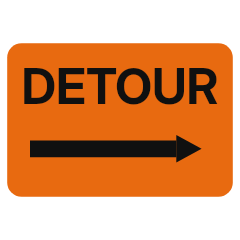
20. Which of these is true of the roadway a driver is being sent onto here?
Show answer
Answer D: Its own signs, signals and speed limits govern for the whole way around
The alternate route is an ordinary public road, so every control posted on it governs as usual; being sent that way grants no extra priority and no relief from the limits in force there.
-
21. How is the yield sign shaped and colored?
Show answer
Answer C: A downward-pointing triangle with a wide red border and a red legend on white
The yield sign is a downward-pointing equilateral triangle with a wide red border and the legend in red on a white background, an outline used for no other message.
-
22. A sign warns that your exit leaves from the left side of the freeway. What should you do?
Show answer
Answer D: Move into the left lane in good time before you reach the exit
Left-hand exits are unusual, which is exactly why they are signed well in advance and why the lane changes should be finished early.
-
23. A farm implement ahead of you on a two-lane road is wider than its own lane. What should you do?
Show answer
Answer D: Hang back until you can see past it and pass only with a clear road
Wide equipment hides the road ahead and may extend farther across the center line than it appears, so the pass needs more room and a much better view.
-
24. Once you are moving, which way of using a navigation device costs you the least attention?
Show answer
Answer B: Listening to the spoken directions
Voice guidance lets you keep your eyes on the road, while anything that needs the screen takes glances that add up over a trip.
-
25. What is a good rule for any task you want to do inside the vehicle?
Show answer
Answer D: If it needs more than a moment, do it stopped
A glance of a second or two is manageable, but any task that runs longer belongs to a stopped vehicle, because the road does not pause while you do it.