
Delaware DMV Motorcycle Practice Test 56
- Questions25
- Correct to pass20
- Passing score80%
- Minimum age18 years
-
1. How long is the license suspension for a first Delaware conviction of passing a stopped school bus?
Show answer
Answer A: 1 month
A first offense costs one month of driving privileges, a second costs six months and a third or later offense costs twelve months.
-
2. What does the thick foam liner inside a certified helmet actually do in a crash?
Show answer
Answer C: It crushes so the head slows down over a longer time and distance
The crushable liner is the part that absorbs energy, letting the head decelerate gradually instead of stopping instantly against a hard surface.
-
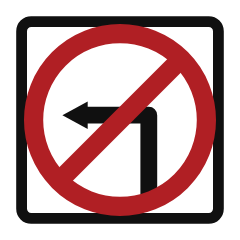
3. A driver in the leftmost lane reaches this sign at an intersection. What must the driver do?
Show answer
Answer B: Go straight on or turn right, and reach the destination another way
The restriction holds whatever the traffic or the signal is doing, so the driver has to pass the intersection and plan a different route.
-
4. On the Interstate system, what do the odd-numbered one and two digit routes have in common?
Show answer
Answer D: They run mainly north and south
Odd numbers are given to north and south Interstates and even numbers to east and west ones, with the numbers rising toward the north and the east.
-
5. Besides a chemical test, what else supports an impaired driving charge?
Show answer
Answer B: The officer's observations of the driving and the driver
Weaving, slow responses, speech and balance observed by the officer are evidence in their own right, which is why a driver can be charged on behavior alone.
-
6. You have begun to move into the next lane when the gap you were aiming for closes. What is the safest action?
Show answer
Answer C: Return to your own lane, cancel the signal and wait for a better gap
An unfinished lane change leaves you in a space that no longer exists, and the lane you came from is still yours.
-
7. A yellow pennant-shaped sign is posted on the left side of a two-lane road facing you. What is it telling you?
Show answer
Answer B: You are entering a no-passing zone and may not start a pass
The pennant is placed on the left so that it faces the driver who might pull out, and it marks the beginning of a no-passing zone.
-
8. In normal operation, which indication always comes between a green and a red on the same signal face?
Show answer
Answer C: A steady yellow
The yellow change interval must follow every green or green arrow, so a signal can never jump straight from green to red.
-
9. You are entering a freeway using an on-ramp with an acceleration lane. What is the correct technique?
Show answer
Answer C: Use the acceleration lane to reach the speed of traffic, then merge into a gap while yielding to traffic already on the freeway
The acceleration lane exists so you can match the speed of freeway traffic before merging, and drivers already on the freeway have the right-of-way.
-
10. What identifies a helmet as certified to the federal motorcycle helmet standard?
Show answer
Answer C: A label showing DOT and the words FMVSS No. 218 CERTIFIED
Certified helmets carry a label with the DOT symbol and the wording FMVSS No. 218 CERTIFIED, together with the maker's name and the model.
-
11. You see brake lights several vehicles ahead of you in your lane. What is the best first step?
Show answer
Answer C: Ease off the gas and cover the brake pedal
Reacting to the trouble several vehicles ahead, rather than waiting for the car in front, cuts your reaction time and warns the driver behind you.
-
12. How should you use your mirrors while another vehicle overtakes you on a multilane road?
Show answer
Answer C: Follow it from the inside mirror to the side mirror and then to your own view
Handing the vehicle from one mirror to the next keeps it in sight through the blind spot instead of losing it there.
-
13. What happens to your field of vision as your speed increases?
Show answer
Answer C: It narrows, so you notice less at the sides of the road
The faster you travel, the more your useful field of view narrows toward the center, so a hazard coming from the side is seen late or missed altogether.
-
14. You are turning right onto a one-way street. Which lane of that street should you enter?
Show answer
Answer C: The lane closest to the right curb
Even though every lane on a one-way street runs your way, a right turn must end in the lane nearest the right curb; you may change lanes afterwards when it is safe.
-
15. Why should a driver crossing several lanes change only one lane at a time?
Show answer
Answer B: Each lane has its own traffic and its own blind spot to be checked
Sweeping across two or three lanes means entering lanes you never checked, so each change gets its own signal, mirror check and head check.
-
16. What is the main source of the noise that damages a rider's hearing?
Show answer
Answer A: Wind turbulence around the helmet, which rises sharply with speed
Wind noise around a helmet is loud enough at highway speed to cause permanent hearing loss over time, which is why earplugs are recommended even on quiet machines.
-
17. What should a pre-ride check of the drive chain or belt look for?
Show answer
Answer C: Correct slack, adequate lubrication and no worn or damaged links
A chain that is too tight, too loose, dry or damaged can break or jump the sprocket and lock the rear wheel while the motorcycle is moving.
-
18. How does the distance needed to stop change when a rider doubles speed?
Show answer
Answer D: It grows to roughly four times the original distance
Braking distance rises with the square of speed, so twice the speed needs roughly four times the distance in which to stop.
-
19. How does driving on overinflated tires affect the vehicle?
Show answer
Answer D: It gives a harsher ride and a smaller contact patch
An overinflated tire bulges in the middle, so less rubber touches the road, grip suffers and the ride becomes hard. The center of the tread wears first.
-
20. Why is a shoulder check especially important on a road with motorcycles and bicycles?
Show answer
Answer D: A narrow vehicle can disappear completely in the blind spot
A motorcycle or a bicycle is small enough to be hidden entirely by a door pillar or by the blind spot the mirrors do not cover.
-
21. How many points does Delaware assess for disregarding a stop sign or a red light?
Show answer
Answer C: 3
Disregarding a stop sign or a traffic signal is assessed at three points, more than an ordinary moving violation but less than reckless driving.
-
22. A city transit bus ahead of you has stopped at the curb with its passenger door open. What does the law require of you?
Show answer
Answer D: Nothing special, but pass slowly and watch for people
The mandatory stop applies to a school bus showing red flashing lights, not to a transit bus, though a careful driver still slows for crossing passengers.
-
23. There is a stop sign but no stop line and no crosswalk. Where must you stop?
Show answer
Answer A: Before entering the intersection, where you can see cross traffic
With no line or crosswalk, stop before you enter the intersection at the point where you can see traffic on the cross street.
-
24. How can a rider check the action of the front suspension while the motorcycle is stationary?
Show answer
Answer D: Hold the front brake on and push down on the bars to feel the forks move and return
Compressing the forks against the front brake shows whether they move smoothly and return without binding, sticking or making noise.
-
25. What is the correct body position for riding over a bump or an obstacle?
Show answer
Answer B: Rise slightly off the seat with your weight on the footrests, absorbing the shock with knees and elbows
Coming slightly off the seat lets your legs and arms work as extra suspension instead of transferring the impact through your body and the handlebars.