
Delaware DMV Motorcycle Practice Test 51
- Questions25
- Correct to pass20
- Passing score80%
- Minimum age18 years
-
1. A broken white line separates your lane from the lane beside it. What does it indicate?
Show answer
Answer C: Both lanes carry traffic in the same direction and lane changes are permitted
White lines separate lanes of traffic moving in the same direction, and a broken white line means changing lanes across it is permitted when it is safe.
-
2. How should the brake light be checked before a ride?
Show answer
Answer D: Confirm that the hand lever and the foot pedal each switch it on
Many motorcycles use a separate switch for each brake control, so both the lever and the pedal have to be tested one at a time.
-
3. A driver ahead brakes for no reason you can see, again and again. What should you do?
Show answer
Answer B: Increase your following distance and be ready for yet another stop
Unexplained braking tells you the driver is unsure or distracted, so the safe answer is more room, not less.
-
4. A ball rolls into the street from between parked cars ahead of you. What should you expect and do?
Show answer
Answer A: Expect a child to follow it and be ready to stop
A ball is usually followed by a child who is watching the ball and not the traffic. Slow down and be prepared to stop immediately.
-
5. When is a wet road usually most slippery?
Show answer
Answer C: Just after the rain starts, before the surface oil is washed away
Oil and dirt lying on the pavement mix with the first water and cut traction badly until continued rain washes the residue to the side of the road.
-
6. Your vehicle has stalled on railroad tracks and no train is in sight. After getting everyone away, whom should you call first?
Show answer
Answer B: The railroad emergency number posted on the blue sign at the crossing, giving the crossing number
Every public crossing has a blue emergency notification sign with a phone number and a crossing identification number. That call lets the railroad stop or slow trains before they reach you.
-
7. An orange sign showing the symbol of a person holding a flag or a sign paddle means that
Show answer
Answer D: a person is controlling traffic ahead and the driver must obey that person
The flagger sign warns that a trained flagger is directing traffic further on, and the flagger's instructions govern movement through the work zone.
-
8. What is the purpose of the engine cut-off switch?
Show answer
Answer B: To stop the engine without letting go of the handgrips
The cut-off switch, usually a red switch near the right handgrip, shuts the engine down while the rider keeps both hands in control of the motorcycle.
-
9. A preferential lane sign reads HOV 2+ and lists the hours it applies. During those hours, which vehicles may use the lane?
Show answer
Answer A: Vehicles carrying at least two people, counting the driver
The number on an HOV sign is the minimum number of occupants, driver included, that a vehicle must carry to use the lane while the restriction is in effect.
-
10. You approach an intersection where the signal is flashing yellow. What should you do?
Show answer
Answer D: Slow down and cross the intersection with caution
A flashing yellow signal warns you to slow down and cross with care; it does not require a stop, but it does not give you priority either.
-
11. The sun is low behind you and shining into the eyes of oncoming drivers. What should you do?
Show answer
Answer C: Turn on your headlights and expect oncoming drivers not to see you
Drivers facing the low sun may not see you at all, so make yourself as visible as possible and give way rather than insisting on your right of way.
-
12. A strong wind is blowing steadily across the road from your left. How should you ride?
Show answer
Answer A: Move toward the left of the lane and lean into the wind
Riding on the windward side of the lane leaves room to be pushed without leaving the lane, and a slight lean into the wind holds the line.
-
13. A sign on a freeway restricts trucks to the two right-hand lanes. What should a car driver expect in those lanes?
Show answer
Answer A: More heavy vehicles and slower changes of speed
A truck lane restriction concentrates heavy vehicles on the right, and those vehicles accelerate, brake and change lanes far more slowly than cars.
-
14. A white regulatory sign near a state line reads BUCKLE UP IT IS THE LAW. What is it doing?
Show answer
Answer A: Reminding occupants that belt use is required
The safety belt sign restates a law that already applies, and it is usually placed where drivers enter a state or a long rural stretch.
-
15. Visibility drops suddenly and you decide to leave the highway. What is the safest way to do it?
Show answer
Answer A: Take the next exit or a wide pull off, well clear of the traffic lanes
Get right off the traveled way, and off the shoulder too if you can, because vehicles in poor visibility often drift onto the shoulder.
-
16. The sign over the leftmost lane reads LEFT LANE MUST TURN LEFT. You are in that lane and want to go straight. What should you do?
Show answer
Answer C: Move out of the lane before the intersection if it is safe
A mandatory movement lane control sign makes the turn compulsory for that lane, so a driver who wants another movement must change lanes in advance.
-
17. Why must the handlebars be kept square during a hard straight line stop?
Show answer
Answer B: Because a front wheel turned under heavy braking can put the machine down
With the front tire loaded to its limit, any steering input asks it to do two jobs at once and the front end can wash out instantly.
-
18. At a rural intersection a beacon flashes yellow toward the main road and red toward the side road. How is each approach treated?
Show answer
Answer A: The main road slows and proceeds, the side road stops
An intersection control beacon assigns flashing yellow to the road with priority and flashing red to the approach that must stop and yield.
-
19. Permanent signs must be retroreflective or lighted so that
Show answer
Answer A: they show the same shape and color at night as by day
Retroreflective sheeting throws headlight light back to the driver, so a sign keeps its daytime shape and color after dark.
-
20. What does the solid white line running along the right side of a highway mark?
Show answer
Answer A: The right edge of the traveled way
A solid white edge line shows where the traveled way ends on the right, which is particularly useful at night and in poor visibility.
-
21. A driver who has been drinking has two cups of strong coffee. What has changed?
Show answer
Answer D: The driver is more awake but just as impaired
Coffee can make a drinker feel alert, but nothing except time removes alcohol from the blood, so a wide awake drinker is still an impaired driver.
-
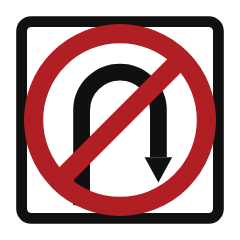
22. A driver who wants to reverse direction arrives at this sign. What is allowed?
Show answer
Answer C: Going on and reversing direction only where the maneuver is permitted
The restriction removes that maneuver at that spot entirely, so the driver has to continue and turn the vehicle around at a place where it is not prohibited.
-
23. A rider signals that they need to stop, although nobody else in the group wants a break. What should happen?
Show answer
Answer A: The group stops, because a rider who needs a break should get one
A rider who is tired, cold or uncomfortable is a hazard to the whole group, and stopping costs far less than the mistake that follows.
-
24. Your green left-turn arrow goes out and a steady green ball stays lit. What may you do?
Show answer
Answer A: Continue turning left, but only after yielding to oncoming traffic
When the arrow ends and a green ball remains, the turn changes from protected to permissive, so it is still allowed but oncoming traffic goes first.
-
25. You are about to accelerate hard to merge with traffic. What should you have arranged with your passenger?
Show answer
Answer D: That you warn them beforehand so they can tighten their grip
A passenger who is not expecting a burst of acceleration is thrown backward, and the sudden shift of weight upsets the machine just when the rider needs it settled.