
Delaware DMV Motorcycle Practice Test 22
- Questions25
- Correct to pass20
- Passing score80%
- Minimum age18 years
-
1. The rider who was behind you has vanished from your mirrors. What should you do?
Show answer
Answer C: Ease off and pass the word forward so the group can respond
A rider missing from the line may have stopped or had trouble, and the group needs to know at once so it can slow down or pull over safely.
-
2. An overhead sign shows that the right lane is EXIT ONLY. What does that mean if you intend to stay on the highway?
Show answer
Answer B: You have to move out of that lane before the exit
An exit only lane leaves the highway completely, so a driver continuing on the highway has to change lanes before it does.
-
3. A pedestrian is crossing at a corner where no crosswalk is painted on the pavement. What is your duty?
Show answer
Answer A: Yield, because a legal crosswalk exists at the corner even without paint
Every intersection has a crosswalk whether or not it is marked, and drivers must yield to pedestrians crossing there.
-
4. Why is the staggered formation abandoned in a curve?
Show answer
Answer D: Because each rider needs the full width of the lane to choose a line through the curve
In a curve every rider must be free to use the whole lane to set up an entry and an exit line, which is impossible while holding a fixed side position.
-
5. You are turning right where a paved trail crosses the road just past the corner. What should you look for?
Show answer
Answer B: Cyclists and walkers arriving from either direction on the trail
A shared use path carries two-way traffic on foot and on bicycles, so scan both directions along the trail before crossing it.
-
6. After the leader of a staggered group completes a pass, what should the leader do?
Show answer
Answer A: Move to the left position and hold passing speed to open room for the next rider
Returning to the left position and keeping speed opens the gap the next rider needs to finish the pass and settle back into formation.
-
7. What should a passenger be told about where to keep their legs?
Show answer
Answer D: To keep them away from the muffler, the chain and other moving parts
Exhaust pipes get hot enough to burn and exposed drive components can catch a loose leg, so the passenger must keep legs in and clear of them.
-
8. You are on a city street with two lanes in your direction, cars parked along the curb and driveways every few yards. Which lane is usually safer?
Show answer
Answer B: The lane farther from the curb, away from opening doors and vehicles pulling out
Most of the hazards on such a street come from the curb side, so the inside lane gives you more space and more time to react.
-
9. What makes a left turn protected rather than permissive?
Show answer
Answer B: Oncoming traffic is held by a red signal while you have a green arrow
A protected turn is one where the conflicting movements are stopped by their own signal, which is what the green arrow indicates.
-
10. You are approaching a refuse collection truck working along your street. What should you expect?
Show answer
Answer D: Workers stepping into the road around the truck
Collection crews move constantly between the truck and the curb, often from where you cannot see them, so slow right down and pass only when the whole area is clear.
-
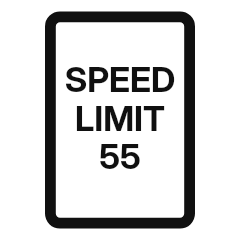
11. On a clear day with light traffic, a driver stays far below the maximum this sign sets. What can that cause?
Show answer
Answer B: Obstruction of the normal flow of traffic, which is prohibited in itself
Driving so slowly that other traffic is impeded is an offense in its own right when nothing about safety, weather or the road calls for it.
-
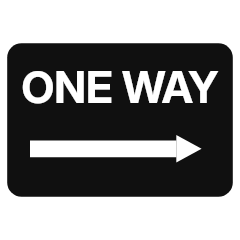
12. A driver on the street this sign governs is preparing to turn left at the next corner. Which lane should the vehicle be in beforehand?
Show answer
Answer A: The lane closest to the left curb
All the traffic here runs the same way, so nothing is coming toward the driver and the turn is taken from the extreme left lane rather than from beside the middle of the roadway.
-
13. Where should a passenger sit on the motorcycle?
Show answer
Answer A: As far forward as possible without crowding the operator
Sitting well forward keeps the passenger weight close to the center of the motorcycle, which helps it handle closer to normal.
-
14. You are behind a slow vehicle on a two-lane road and a marked passing lane begins a mile ahead. What is the sensible choice?
Show answer
Answer D: Wait for the passing lane rather than using the opposing lane
A passing lane lets you overtake without ever entering the lane used by oncoming traffic, which is far safer than a pass a minute earlier.
-
15. How should your following distance change in heavy rain?
Show answer
Answer D: It should be increased well beyond what you use on dry pavement
Wet pavement lengthens stopping distance and rain cuts visibility at the same time, so a larger gap gives you the extra seconds needed to see a problem and stop for it.
-
16. Two left-turn lanes are marked at the intersection and you are in the left one. What must you do?
Show answer
Answer A: Stay in your own lane all the way around the turn
With dual turn lanes each driver must hold a lane through the whole turn and come out in the matching lane of the new street.
-
17. Why should riding boots come above the ankle?
Show answer
Answer C: The ankle is easily broken and is left bare by a low shoe
The ankle takes a lot of damage when a motorcycle goes down or a foot is trapped, and a low shoe leaves it completely unprotected.
-
18. A pedestrian steps off the curb without looking your way. What should you assume?
Show answer
Answer B: That the person has not seen you at all, and be ready to stop for them
Defensive driving means assuming you have not been seen until there is clear evidence that you have.
-
19. Many signs use a symbol instead of words. The main advantage is that a symbol
Show answer
Answer C: can be read from farther away and by more people
A symbol is recognized at greater distance than a line of text and does not depend on the reader knowing English.
-
20. A law enforcement officer is directing traffic and waves you forward while the signal facing you shows red. What should you do?
Show answer
Answer A: Follow the officer's direction and proceed
Directions given by an officer controlling traffic take priority over signals, signs and pavement markings.
-
21. It is cold and the road looks wet, but you notice the tires of vehicles ahead are throwing up no spray. What does this suggest?
Show answer
Answer B: The surface has frozen and is probably icy
Water throws spray, but ice does not. A shiny road with no spray in freezing temperatures is a strong sign of black ice, so slow down and avoid sudden inputs.
-
22. What limits how much weight a motorcycle can carry?
Show answer
Answer A: The load limit given by the manufacturer for that machine
The manufacturer's figure covers the rider, the passenger and everything carried, and going over it overloads the tires, the brakes and the suspension.
-
23. You are parked legally, but a police officer tells you to move the vehicle. What should you do?
Show answer
Answer B: Move it as directed, because an officer overrides the signs
Directions from a police officer or a firefighter take precedence over signs and markings, whether they are directing traffic or clearing a street.
-
24. In heavy stop-and-go traffic, why does using both lanes right up to a merge point help?
Show answer
Answer D: It stores the queue in two lanes, so the backup is shorter
Filling both lanes halves the length of the queue and keeps it away from the traffic upstream, which is why alternating at the merge point works better when traffic is slow.
-
25. On a narrow residential street, why does parking tight against the curb matter so much?
Show answer
Answer C: Because fire trucks and ambulances need the width to get through
Cars parked even a foot out from the curb on both sides can narrow a street until a fire truck or ambulance cannot pass.