
Delaware DMV Permit Practice Test 32
- Questions32
- Correct to pass26
- Passing score81%
- Minimum age16 years
-
1. Why is being thrown out of a vehicle in a crash so dangerous?
Show answer
Answer C: Because you strike the road or other objects at high speed, and rarely survive
Ejection is one of the deadliest outcomes of a crash, and a fastened belt is what keeps a person inside the vehicle.
-
2. How much following distance should you keep behind a motorcycle?
Show answer
Answer C: At least three to four seconds
A motorcycle can slow or stop very quickly and is easily upset by a surprise, so allow three to four seconds instead of the usual car gap.
-
3. How often should the spare tire be checked?
Show answer
Answer C: Regularly, because a spare loses pressure while it sits unused
Spares lose air slowly over months, and a flat spare is useless at the moment you need it.
-
4. Which headlight setting should you use in dense fog?
Show answer
Answer B: Low beams
High beams reflect off the water droplets in fog and bounce glare back at you, while low beams aim downward and light the road without that mirror effect.
-
5. A funeral procession with headlights on is crossing an intersection when your light turns green. What should you do?
Show answer
Answer A: Wait and let the whole procession go through
Most states let a funeral procession stay together once the lead vehicle has lawfully entered an intersection, and in every state you must yield to vehicles already in the intersection, so wait until the line has passed.
-
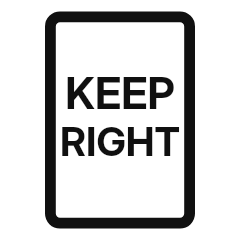
6. A driver ignores this sign and passes on the opposite side. What is the main risk?
Show answer
Answer B: Ending up on the wrong side of a divider, facing traffic coming the other way
The sign settles which side of a fixed divider is the legal one, so taking the other side sends the vehicle into the opposing stream or straight at the obstruction.
-
7. A SHOULDER DROP OFF sign warns that
Show answer
Answer B: there is a step down from the pavement to the shoulder
The sign is used where the edge of the pavement stands several inches above the shoulder, which can grab a wheel and pull the vehicle sideways.
-
8. You are driving down a parking aisle and reach the main lane that runs along the front of the store. What is the usual rule?
Show answer
Answer C: The main through lane has the right of way over the vehicles leaving the aisles
In a parking lot the wide lane that runs across the ends of the aisles works like a through road, and drivers leaving an aisle yield to it.
-
9. Which surfaces usually offer less grip than the pavement around them when wet?
Show answer
Answer B: Painted markings, metal plates and bridge decks
Paint, steel and bridge decks all shed grip when wet or cold, so brake before you reach them rather than on top of them.
-
10. Is it acceptable to watch a video on a screen positioned where you can see it while driving?
Show answer
Answer B: No, the screen pulls your eyes and attention away from the road
Moving pictures are among the strongest visual distractions. Video screens must be out of the driver's view while the vehicle is moving.
-
11. You are passing a large truck on an open highway in a strong crosswind. What should you expect?
Show answer
Answer A: A push toward the truck, then a push the other way as you clear it
The truck shelters you as you go by and then releases you into the full gust, so the load on the steering changes twice during the pass.
-
12. You are already inside an intersection when you realize you should be in the lane beside you. What should you do?
Show answer
Answer C: Stay in your lane through the intersection and change lanes afterwards
Drivers in an intersection are watching for cross traffic and turning vehicles, so an unexpected sideways move there is easily missed.
-
13. A yellow sign ahead of an underpass reads LOW CLEARANCE 12 FT 6 IN. What does the figure tell you?
Show answer
Answer B: The greatest height that can pass beneath the structure
The figure is the actual clearance available, so a vehicle taller than that must leave the road and take a marked alternative route.
-
14. A diamond-shaped sign is used to
Show answer
Answer A: warn of a condition on or next to the road that may call for caution
The diamond is the standard shape of the warning series, which alerts drivers to conditions that would otherwise not be obvious in time to react.
-
15. Why should you not rest your foot on the brake pedal as you drive?
Show answer
Answer D: The brake lights stay on and the drivers behind cannot read you
Resting on the pedal keeps the brake lights lit and wears the brakes, so following drivers stop believing your brake lights.
-
16. Besides the hours from sunset to sunrise, when does Delaware require headlights to be lit?
Show answer
Answer D: Whenever fog, smoke or rain makes the wipers necessary
Delaware requires headlights during fog, smoke or rain and whenever the windshield wipers are in use, as well as when visibility falls short of 1,000 feet.
-
17. On a narrow residential street, why does parking tight against the curb matter so much?
Show answer
Answer C: Because fire trucks and ambulances need the width to get through
Cars parked even a foot out from the curb on both sides can narrow a street until a fire truck or ambulance cannot pass.
-
18. You are already inside a roundabout when an emergency vehicle approaches with lights and siren. What should you do?
Show answer
Answer B: Continue to your exit, leave the roundabout, then pull over and stop
Stopping inside a roundabout blocks the circulating roadway, so you should exit first and then pull over clear of the intersection.
-
19. You have turned right into the nearest lane but you need the left lane soon. When should you move over?
Show answer
Answer A: After the turn is finished, once you have checked mirrors and blind spot
Complete the turn in the proper lane first, then make a normal lane change with mirror and blind spot checks once you are established on the new street.
-
20. You pass into a work zone with a reduced speed limit but you see no workers. What speed applies?
Show answer
Answer D: The posted work zone limit, whether or not workers are present
A posted work zone speed limit is a regulatory limit in force at all times, and narrow lanes and uneven surfaces remain dangerous when nobody is working.
-
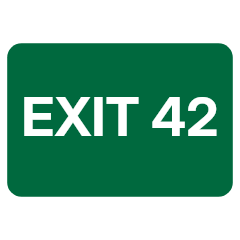
21. A driver in the left lane of a freeway realizes only when level with this sign that the ramp beside it is the one they need. What is the correct action?
Show answer
Answer A: Carry on to the next interchange and turn back from there
There is no safe way back to a ramp once it has been reached from the wrong lane, so the driver keeps going to the next interchange, where the ramps are built for that movement.
-
22. Which vehicle is most affected by a strong side wind?
Show answer
Answer D: A van or a car towing a tall trailer
Wind pushes against the side area of a vehicle, so tall boxy shapes and trailers are moved far more than low heavy ones.
-
23. A traffic signal is dark and you reach the intersection at the same moment as a vehicle on your right. Who goes first?
Show answer
Answer A: The vehicle on your right, as at any all-way stop
A dark signal is treated as an all-way stop, and the usual tie-breaker then applies: the vehicle on the right goes first.
-
24. Which common non-prescription medicine is most likely to make a driver drowsy?
Show answer
Answer C: A cold or allergy remedy containing an antihistamine
Antihistamines in cold and allergy remedies are a leading cause of drowsiness behind the wheel, which is why the label carries a warning.
-
25. A single solid white line separates two lanes running in the same direction. What is it telling drivers?
Show answer
Answer A: Changing lanes there is discouraged
A solid white lane line discourages lane changing, typically where merging or weaving would create a hazard.
-
26. You are turning left from a one-way street onto a two-way street. How should the turn be made?
Show answer
Answer B: Start in the far left lane and finish just to the right of the center line
Left turns begin from the lane nearest the left edge of the street you are leaving and must finish on the right-hand side of the center line of a two-way street.
-
27. How long is the revocation for a first Delaware DUI where the alcohol concentration was at least 0.15 but less than 0.20?
Show answer
Answer B: 18 months
That concentration band lengthens the first offense revocation from twelve to eighteen months.
-
28. On a busy multilane highway, where is the best place to travel?
Show answer
Answer B: In a gap in the traffic, with space open on both sides
Travelling in a gap keeps escape routes open on both sides, while riding alongside other vehicles removes the room you would need to swerve.
-
29. What should you do before leaving a parked vehicle unattended?
Show answer
Answer C: Set the parking brake, place the transmission in park or in gear, switch off the engine and take the key
Securing the vehicle with the parking brake, the transmission and the ignition prevents it from rolling away and from being moved by someone else.
-
30. You are driving at night on an unlit road using low beams. How should you choose your speed?
Show answer
Answer C: So you could stop within the distance your headlights light up
Driving faster than you can stop within the lit area is called overdriving your headlights. Anything beyond the beam is invisible until it is too late to react.
-
31. You have a green light and an ambulance with lights and siren enters the intersection against its red. What should you do?
Show answer
Answer B: Stop and let the ambulance go through
An emergency vehicle answering a call may cross against a red, and every other driver yields to it whatever their own signal shows.
-
32. How should your speed behave while you move from one lane into the next?
Show answer
Answer C: Keep it steady or adjust it smoothly to match the traffic in the new lane
A lane change works best as a smooth movement at the speed of the lane you are joining, since sudden braking or acceleration surprises the drivers around you.