
Delaware DMV Permit Practice Test 27
- Questions32
- Correct to pass26
- Passing score81%
- Minimum age16 years
-
1. What minimum visible light transmission does Delaware require for a front side window?
Show answer
Answer A: At least 50 percent
Delaware requires front side windows to transmit at least 50 percent of visible light, while rear windows have no such floor.
-
2. Why is the road often most slippery during the first few minutes of rain after a long dry spell?
Show answer
Answer C: Oil and dust on the surface mix with the water into a slick film
Oil drippings and road dust build up on dry pavement, and the first light rain lifts them into a slippery film before heavier rain washes it away.
-
3. On a regulatory sign, what does a red circle with a diagonal slash drawn over a symbol mean?
Show answer
Answer D: The movement or action shown by the symbol is prohibited
A red circle with a diagonal slash is the standard way of showing that the movement pictured inside it, such as a U-turn or a right turn, is not allowed.
-
4. A regulatory message is normally carried on a sign whose shape is
Show answer
Answer A: a rectangle standing taller than it is wide
Regulatory signs that state a law, such as speed limits and turn restrictions, use a vertical rectangle with a black legend on a white background.
-
5. The traffic around you is moving well above the limit on a wide highway. What should you do?
Show answer
Answer D: Keep to the limit and stay to the right, letting faster traffic pass
The limit is a legal maximum, and the safe way to differ from the traffic around you is to keep right and let it go by.
-
6. Which of these would appear as a symbol on a blue general service sign?
Show answer
Answer A: A hospital
General service signs cover facilities such as hospitals, fuel, food, lodging, camping, telephones and rest areas, all shown in white on blue.
-
7. A school bus ahead of you has its red lights flashing and its stop arm extended. What are you required to do?
Show answer
Answer A: Stop and stay stopped until the lights stop flashing and the bus starts moving
Flashing red lights and an extended stop arm mean children are getting on or off, so traffic must stop and wait until the bus withdraws the signals and moves again.
-
8. Should you drive with your hazard lights flashing while moving in fog?
Show answer
Answer A: No, they hide your turn signals and suggest you are stopped
Hazard lights on a moving vehicle tell other drivers you are stopped or disabled, and they cancel out your turn signals just when clarity matters most.
-
9. How much clear road do driver manuals say you need before starting a pass at highway speed on a two-lane road?
Show answer
Answer C: Enough to complete the pass and return, roughly ten to twelve seconds of travel
At highway speed the whole maneuver of pulling out, overtaking and returning takes roughly ten to twelve seconds, and every foot of that has to be visible before you start.
-
10. You drive onto a section where the top layer has been milled off and the surface is grooved. How will it feel?
Show answer
Answer C: The steering may wander, so hold the wheel firmly and slow down
Grooves cut into the pavement tug at the tires and make the steering feel restless. A firm grip and a lower speed keep the vehicle tracking straight.
-
11. A truck ahead of you is spreading salt or grit on the road. What should you do?
Show answer
Answer B: Drop back so the material does not reach your car
Spreaders throw material backward and sideways, and following close means stone chips and a screen full of spray, so leave extra distance.
-
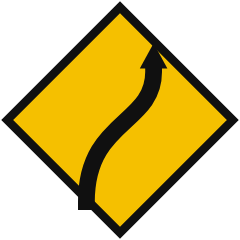
12. What does this sign tell a driver about the road ahead?
Show answer
Answer A: The roadway changes direction ahead, so speed should be reduced before reaching it
It gives advance notice of a change in alignment so the driver can slow down before entering, since braking inside a bend uses up grip that is needed for steering.
-
13. What does Delaware allow a Level 1 Learner's Permit holder to do with a mobile phone while driving?
Show answer
Answer A: Nothing; the permit bars device use while driving
The permit holder may not operate a vehicle while using a cellular telephone, text messager or similar device, and doing so counts as negligent operation.
-
14. The red lights on a stopped school bus go out and the bus begins to move away. What should you do?
Show answer
Answer B: Move off slowly and keep watching for children near the road
Children who have just left the bus may still be near the roadway or crossing behind it, so pull away gently and keep looking for them.
-
15. Two solid yellow lines are painted down the center of a two-way road. What do they mean?
Show answer
Answer B: Traffic in neither direction may cross them to pass
A double solid yellow line marks a no-passing zone that applies to traffic traveling in either direction.
-
16. You are joining a highway from a short ramp that has no acceleration lane. What should you do?
Show answer
Answer A: Stop or slow at the end of the ramp and wait for a safe gap
Without an acceleration lane there is no room to match speed, so you must yield at the end of the ramp and enter only when a gap allows it.
-
17. When should you enter a destination into a navigation device?
Show answer
Answer B: Before you start driving, or after parking in a safe place
Programming a route is a visual, manual and mental task at the same time, so it belongs to the moments before the vehicle moves rather than to any point in traffic.
-
18. Where is a strong crosswind most likely to hit you suddenly?
Show answer
Answer D: Coming out of a tunnel or a cut onto an open bridge
Gusts arrive the moment you leave shelter, which is why bridge approaches and the ends of cuts and tunnels catch drivers out.
-
19. Your vehicle stalls on a railroad crossing and will not restart. What should you do first?
Show answer
Answer A: Get everyone out and away from the tracks immediately
Everyone must leave the vehicle and move well clear of the tracks at once, walking toward the train at an angle so that debris from an impact travels away from you.
-
20. What is the safest way to pass a bicyclist on a road with two lanes going your way?
Show answer
Answer D: Change lanes completely, as you would for a car
A bicycle is entitled to the room a vehicle needs, and moving into the next lane gives the rider space to swerve around a drain or a pothole.
-
21. There is a driveway and a side street between you and the corner where you will turn right. When should you signal?
Show answer
Answer C: After passing the openings, so nobody pulls out in front of you
A signal switched on before an opening tells drivers waiting there that you are turning in, and they may pull out into your path.
-
22. Which of these makes you unpredictable to other drivers?
Show answer
Answer B: Changing lanes suddenly without signaling, to save a moment
An unsignalled, sudden lane change gives nobody time to react and is a common cause of sideswipe collisions.
-
23. What penalty does Delaware set for a first offense of possessing a fictitious insurance identification card?
Show answer
Answer A: A fine of 500 to 1,500 dollars or 30 to 60 days in jail
Possessing or manufacturing a fictitious insurance identification card carries a fine of 500 to 1,500 dollars or 30 to 60 days of imprisonment on a first offense.
-
24. You are traveling a long distance on a highway with three lanes in your direction, at about the speed of the surrounding traffic. Which lane is generally the best choice?
Show answer
Answer C: The center lane, which keeps you clear of merging traffic and of overtaking traffic
On a three-lane roadway the center lane avoids both the ramp traffic on the right and the overtaking traffic on the left, so it usually has the steadiest flow.
-
25. How should you position your vehicle for a right turn from a two-way street?
Show answer
Answer B: As close as practical to the right curb or edge, then turn into the nearest right lane
Right turns are made from the lane nearest the right edge into the nearest available lane, which keeps the turn tight and prevents a wide sweep into other traffic.
-
26. May you exceed the posted speed limit in order to complete a pass?
Show answer
Answer C: No, the posted limit applies while you are passing too
The limit does not lift for passing; if you cannot complete the pass within it, there is not enough room and you should stay back.
-
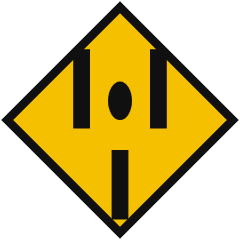
27. What should a driver do first after passing this sign?
Show answer
Answer A: Move into the right-hand lane and stay there
Traffic returns to two-way operation, so the driver keeps to the right of the centerline and stops treating the left side as available.
-
28. Your road ends at a T-intersection with no signs or signals. Who has the right-of-way?
Show answer
Answer A: Traffic on the through road, and you must yield before entering
A driver on a road that ends at a T-intersection must yield to traffic on the through road that continues past the junction.
-
29. In slow summer traffic the temperature gauge climbs into the red. What should you do first?
Show answer
Answer A: Turn off the air conditioner and turn on the heater to draw heat from the engine
The heater core acts as an extra radiator, and shutting off the air conditioner reduces engine load. If the gauge keeps climbing, pull over and shut off the engine, and never open a hot radiator cap.
-
30. Which use of a phone stays legal for a Delaware driver whose vehicle is in motion?
Show answer
Answer B: Using the device hands free without holding it
The ban applies to using a handheld device; operating the same device hands free, without holding it, is excepted.
-
31. How is the yield sign shaped and colored?
Show answer
Answer C: A downward-pointing triangle with a wide red border and a red legend on white
The yield sign is a downward-pointing equilateral triangle with a wide red border and the legend in red on a white background, an outline used for no other message.
-
32. What is the function of a regulatory sign?
Show answer
Answer A: To inform road users of traffic laws or regulations that apply at that location
Regulatory signs state requirements that carry the force of law where they are posted, so disregarding one is a violation rather than a lapse of judgment.