
Delaware DMV Permit Practice Test 21
- Questions32
- Correct to pass26
- Passing score81%
- Minimum age16 years
-
1. How is the Delaware seat belt requirement for occupants aged 16 and older enforced?
Show answer
Answer D: As a primary offense with a 25 dollar civil penalty and no points
Delaware law lets an officer stop a vehicle solely to enforce the belt requirement, and where there is no other violation the civil penalty is 25 dollars with no points and no entry on the driving record.
-
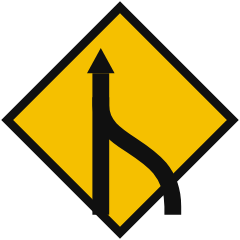
2. What does this sign warn a driver about?
Show answer
Answer A: Traffic from another roadway will enter the same lane ahead
Two traffic streams come together into one lane beyond this point, so drivers on both roadways have to adjust speed and spacing to fit together.
-
3. Your headlights suddenly go out while you are driving at night. What should you do?
Show answer
Answer A: Try the dimmer switch and the headlight switch, turn on the hazard lights and pull off the road
Switching between high and low beams or cycling the light switch sometimes restores the lights. If not, use the hazard and parking lights to get off the road safely.
-
4. You have just been involved in a crash on a city street. Which sequence of first steps is correct?
Show answer
Answer A: Stop where you are, check everyone for injuries, and then make the scene safe
You are required to stop, and the first priority at the scene is people, followed by preventing a second collision.
-
5. Well before an intersection, an overhead sign shows a diagram of the lanes with an arrow above each one. What is its purpose?
Show answer
Answer C: To let drivers pick the correct lane in good time
Advance intersection lane control signs display the lane assignment far enough back that drivers can move over calmly instead of at the last moment.
-
6. Some toll facilities use signs and markings with a purple background or a purple stripe. What do they identify?
Show answer
Answer D: Lanes reserved for vehicles with an electronic toll account
Purple is assigned to lanes and ramps restricted to vehicles with a registered electronic toll collection account, so drivers without one must stay out.
-
7. For which applicants does Delaware extend Level 1 Learner's Permit eligibility past the usual upper age?
Show answer
Answer D: Students enrolled in a special education program
Delaware allows special education students to obtain the Level 1 Learner's Permit up to age 21 rather than being limited to the usual teenage range.
-
8. You hear a bang and one of the front tires deflates while you are on the highway. What happens to the vehicle?
Show answer
Answer D: It pulls strongly toward the side that failed
The collapsed tire drags heavily on that corner, so the vehicle veers toward it. Hold the wheel firmly, keep your line and let the speed fall before leaving the road.
-
9. You are approaching an uncontrolled intersection on a residential street where parked cars hide the cross street. What is the correct approach?
Show answer
Answer B: Slow enough to stop and creep out until you can see
Without a sign or signal you still have to be able to yield, and you cannot yield to traffic you have not seen.
-
10. An oncoming driver flashes their headlights while you are waiting to turn left. What should you do?
Show answer
Answer D: Judge the situation yourself, since the flash may mean something else
A flash is not a legal signal and may mean many things, so the decision to turn stays yours and must be based on what you can see.
-
11. A bus stopped at the corner hides the crosswalk you are about to turn across. What should you do?
Show answer
Answer C: Turn slowly, ready to stop for anyone stepping out in front of it
People often step into the road from in front of a stopped bus, so approach the hidden crosswalk slowly and be ready to stop.
-
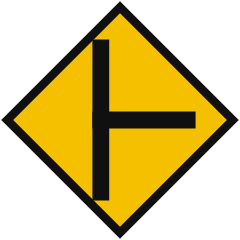
12. What condition does this sign warn a driver about?
Show answer
Answer B: Another road joins the road being traveled, from one side
It announces a side road entering the main roadway, so the driver should expect vehicles waiting to pull out and other vehicles slowing to turn in.
-
13. While driving on a Delaware Level 1 Learner's Permit, how many passengers besides the supervising driver may ride with the permit holder?
Show answer
Answer A: One
Throughout the first 12 months of the Level 1 permit only one passenger beyond the supervising driver is allowed, although immediate family members are exempt when the supervisor is present.
-
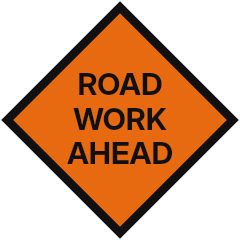
14. How should speed and following distance be adjusted beyond this sign?
Show answer
Answer D: Cut speed and leave a longer gap, because traffic can stop without warning
Traffic in these areas stops and starts unexpectedly and there is little room to steer around a problem, so extra space is what prevents a rear-end collision.
-
15. A raised area crosses the roadway and carries a series of white markings on its face. What are those markings for?
Show answer
Answer A: To make the hump visible so drivers slow for it
Speed hump markings warn drivers that the pavement rises, which matters most at night or when the hump is in shadow.
-
16. You are entering an angle parking space on your right. What should you do?
Show answer
Answer C: Stay a little left of the space, then turn in between the lines
Keeping a little left of the space gives the front wheels the room to turn in cleanly and leaves your car centered between the lines.
-
17. A broken white line separates your lane from the lane on your right. What does it permit?
Show answer
Answer C: Changing lanes when it is safe to do so
A normal broken white line marks a boundary between lanes traveling the same way that road users may cross when it is safe.
-
18. The sign over the leftmost lane reads LEFT LANE MUST TURN LEFT. You are in that lane and want to go straight. What should you do?
Show answer
Answer C: Move out of the lane before the intersection if it is safe
A mandatory movement lane control sign makes the turn compulsory for that lane, so a driver who wants another movement must change lanes in advance.
-
19. The school bus stop ahead sign is installed where
Show answer
Answer C: a school bus stop cannot be seen from far enough away by approaching drivers
This school warning sign is used in advance of a bus stop that lacks adequate sight distance and cannot be relocated, so drivers are warned before the stopped bus comes into view.
-
20. You are in a minor collision on a busy road. No one is hurt and both vehicles can be driven. What is the recommended thing to do?
Show answer
Answer C: Move the vehicles out of the travel lanes to a safe spot before exchanging information
Vehicles left in traffic after a minor crash invite a second, often worse, collision. Clearing the lane protects everyone, and you still exchange details and report as required.
-
21. You are parking on a one-way street where parking is allowed on both sides. What must still be true?
Show answer
Answer D: The vehicle must face the direction the traffic flows
Either curb may be used on a one-way street where signs allow it, but the vehicle must always be headed in the direction traffic moves.
-
22. A yellow diamond shows an arrow bent into a series of reversing turns. What does it warn about?
Show answer
Answer A: Three or more changes of direction close together
The winding road sign replaces a string of separate curve signs where several bends follow one another with only short straights between them.
-
23. You are inside a tunnel with no shoulder when an ambulance comes up behind you with lights and siren. What should you do?
Show answer
Answer D: Keep going at a safe speed and pull over once you are clear of the tunnel
Stopping in a tunnel or on a narrow bridge blocks the only lane, so continue at a safe speed to the first place where you can pull clear.
-
24. What is the safest way to deal with a vehicle sitting in your blind spot?
Show answer
Answer A: Slow a little or move ahead so that it is no longer beside you
You cannot control the other driver, but you can change your own speed so that the vehicle is no longer hidden beside you.
-
25. The posted limit is 55 mph, but heavy traffic and rain make that speed unsafe. What does the law expect of you?
Show answer
Answer D: You must slow to a speed that is safe for the conditions
The basic speed rule requires a speed that is reasonable for the traffic, weather and road, and that speed is often well below the posted maximum.
-
26. How can you check that you are keeping a safe following distance?
Show answer
Answer A: Count at least three seconds between the vehicle ahead passing a fixed object and your reaching it
Pick a fixed roadside object, start counting when the vehicle ahead passes it and make sure at least three seconds elapse before you reach it, adding more time in poor conditions.
-
27. The center line beside your lane is solid yellow while the opposite side has a broken yellow line. What does this mean?
Show answer
Answer D: You may not pass, but traffic in the other direction may
A solid yellow line on your side of the center marks a no-passing zone for your direction only, while the broken line grants the opposing direction a passing zone.
-
28. Your light turns green, but a vehicle is still in the middle of the intersection. What should you do?
Show answer
Answer D: Wait until the intersection is clear before you move ahead
A green light means go only when the way is clear. Drivers already inside the intersection must be allowed to finish crossing.
-
29. A yellow diamond shows an arrow that doubles back on itself. What kind of curve lies ahead?
Show answer
Answer C: A turn of 135 degrees or more, nearly doubling back
The hairpin curve sign is used where the road changes direction by 135 degrees or more, and it is normally backed up by chevrons or a large arrow through the bend.
-
30. The road ahead is broken up with potholes and rough patches. What should you do?
Show answer
Answer C: Slow down, since a hole hit at speed can wreck a tire or wheel
A lower speed cuts the impact on tires, wheels and suspension and gives you time to choose a line through the rough surface.
-
31. You are stopped in traffic at a red light when an ambulance comes up behind you with its siren on. What is the correct action?
Show answer
Answer D: Stay put until you can move aside legally and safely
You must not run a red light or make an unsafe move to yield; wait, then pull to the side once the way ahead lets you do it safely.
-
32. You are approaching the entry of a modern roundabout. Who must you yield to?
Show answer
Answer C: Traffic already circulating in the roundabout, which approaches from your left
Traffic in a United States roundabout circulates counterclockwise, so drivers entering must look left and yield to vehicles already in the circulating roadway.