
Delaware DMV Permit Practice Test 19
- Questions32
- Correct to pass26
- Passing score81%
- Minimum age16 years
-
1. You stop at the curb on a busy street to let passengers out. What should you tell them?
Show answer
Answer A: To get out on the curb side, away from traffic
Passengers should always leave on the side away from moving traffic, which keeps both them and the door out of the travel lane.
-
2. You are stopped at the yield line of a roundabout when an emergency vehicle comes up behind you with lights and siren. What should you do?
Show answer
Answer A: Stay out of the roundabout and pull over to the right of your lane if there is room
Never enter a roundabout ahead of an emergency vehicle and never stop inside one; wait clear of the entry so the crew can get through.
-
3. What do zero tolerance laws mean for a driver who is under 21?
Show answer
Answer B: They commit a violation at an alcohol level far below the adult limit
Drivers under 21 may not legally drink, so every state sets a limit far below the adult one and treats even a trace reading as a violation. The exact figure is set by each state, and the penalty usually includes losing the license.
-
4. Why should you not switch the engine off while the vehicle is still moving fast?
Show answer
Answer B: You lose power steering and the steering may lock
With the engine off the steering becomes very heavy and on many vehicles the column can lock, so shift to neutral first and only shut down once stopped.
-
5. Why must you never leave the engine running in a closed garage?
Show answer
Answer B: Because carbon monoxide builds up and can kill within minutes
Exhaust gas contains carbon monoxide, which has no smell or color and can reach fatal levels in an enclosed space very quickly.
-
6. What must a Delaware applicant under 18 have completed before any Class D license is issued?
Show answer
Answer B: An approved driver education course
Delaware requires an applicant to complete an approved driver education course before turning 18 in order to receive a Class D license.
-
7. You are on a one-way street with two marked lanes. May you pass a slower vehicle on the right?
Show answer
Answer A: Yes, using the right lane, provided that the move is safe and signaled
On a roadway with two or more marked lanes in your direction, moving into the free lane and going by is a normal lane change rather than an unlawful pass.
-
8. The trapezoid sign shape is associated with
Show answer
Answer C: recreational and cultural interest area signing
The trapezoid is used for recreational and cultural interest area guide signs and for national forest route markers.
-
9. A driver's blood alcohol concentration is below the legal limit, but the driver is visibly impaired. Can the driver be arrested?
Show answer
Answer C: Yes, driving while impaired by alcohol is an offense at any concentration
The per se figure, 0.08 percent in most states and 0.05 percent in Utah, is the level at which impairment is presumed. Impairment shown by driving behavior and field tests is enough on its own, because alcohol affects skills well before that number.
-
10. Your loaded vehicle weighs more than the figure shown on a posted weight limit sign. What must you do?
Show answer
Answer D: Find another route, because crossing is not permitted
A posted weight limit is a legal maximum, not advice, so an overweight vehicle has to take a different route.
-
11. What makes up the total distance needed to bring a vehicle to a stop?
Show answer
Answer A: The distance covered while you perceive the hazard, the distance covered while you react, and the braking distance
Total stopping distance combines the ground covered while you notice the hazard, the ground covered while you move your foot to the brake, and the ground covered while the brakes slow the vehicle.
-
12. Why is a sign reading BRIDGE ICES BEFORE ROAD worth heeding even when the road itself is merely wet?
Show answer
Answer C: Cold air passes under a bridge as well as over it
A bridge deck loses heat from below as well as above, so it can be frozen while the road on either side of it is only wet.
-
13. Where does part of each 100 dollar Delaware handheld device penalty go?
Show answer
Answer B: To the Volunteer Ambulance Company Fund
Twenty dollars out of each 100 dollar penalty is directed to the Volunteer Ambulance Company Fund.
-
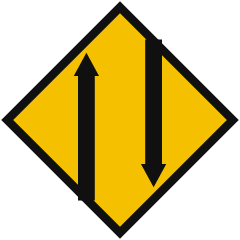
14. What is a driver being warned about here?
Show answer
Answer B: The pavement ahead carries vehicles traveling in the opposite direction
Beyond this point vehicles come the other way on the same pavement, which commonly happens where a one-way section or a separated stretch comes to an end.
-
15. You have a green left-turn arrow but a pedestrian is still walking in the crosswalk you must cross. What should you do?
Show answer
Answer B: Wait until the crosswalk is clear before turning
A green arrow protects you from other vehicles, but it never removes the duty to yield to a person already in the crosswalk.
-
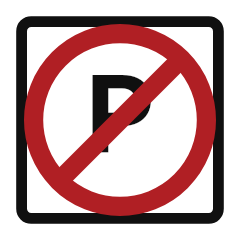
16. Why is this restriction so common beside fire hydrants, crosswalks and intersection corners?
Show answer
Answer C: To keep sight lines open and leave access for emergency crews
A vehicle left in those places hides pedestrians from approaching drivers, blocks the path of turning vehicles and can keep firefighters from reaching a hydrant.
-
17. An overhead lane signal shows a flashing yellow X above your lane. What does it mean?
Show answer
Answer D: The lane may be used only for a left turn
A flashing yellow X marks a lane that may be used only to make a left turn; a steady yellow X is the one that warns you to leave the lane.
-
18. Why is dusk one of the harder times of day to drive?
Show answer
Answer B: The failing light blurs shapes into the background
In fading light there is not enough contrast to pick objects out, yet it is not dark enough for headlights to do the work, so pedestrians and cyclists disappear.
-
19. A police officer is directing traffic at an intersection and waves you through a red light. What should you do?
Show answer
Answer C: Follow the officer, whose directions come before signs and signals
Directions given by a police officer or an authorized flagger override signs, signals and pavement markings.
-
20. A sign on a freeway restricts trucks to the two right-hand lanes. What should a car driver expect in those lanes?
Show answer
Answer A: More heavy vehicles and slower changes of speed
A truck lane restriction concentrates heavy vehicles on the right, and those vehicles accelerate, brake and change lanes far more slowly than cars.
-
21. Two roads come together at a shallow angle under a MERGE sign, with no yield line on either one. What is expected of you?
Show answer
Answer D: Adjust your speed and position so you blend smoothly into the other traffic
A merge means neither road ends at a stop; drivers adjust speed and position so that the two streams fit together without stopping.
-
22. On a divided highway you see a median opening marked for authorized vehicles only. May you use it to turn around?
Show answer
Answer D: No, those openings are for emergency and maintenance vehicles
Official crossovers are reserved for emergency and highway maintenance use; turning there puts a slow vehicle across high-speed traffic.
-
23. In heavy stop-and-go traffic, why does using both lanes right up to a merge point help?
Show answer
Answer D: It stores the queue in two lanes, so the backup is shorter
Filling both lanes halves the length of the queue and keeps it away from the traffic upstream, which is why alternating at the merge point works better when traffic is slow.
-
24. What does a booster seat do for a child?
Show answer
Answer B: It lifts the child so that the adult belt crosses hips and shoulder
A booster raises the child so the adult belt lies on the strong parts of the body instead of the neck and the abdomen.
-
25. Delaware's left lane travel restriction in section 4114A applies to which roadways?
Show answer
Answer A: State Route 1 and Interstate 495
The restriction applies to the parts of State Route 1 and Interstate 495 classified as an express highway or controlled-access facility.
-
26. When should most of your braking for a turn be finished?
Show answer
Answer B: Before you begin to turn the wheel
Slow to the right speed before the turn begins; braking hard while turning uses up the grip the tires need for steering.
-
27. A large truck is passing you on a two-lane road. What is the safest thing to do?
Show answer
Answer C: Keep right in your lane and ease off the gas a little
Staying in your own lane and easing off shortens the pass without forcing you onto a soft shoulder or into the truck's path.
-
28. Is it acceptable to drive far below the flow of traffic on an open highway?
Show answer
Answer B: No, driving too slowly can obstruct traffic and create a hazard
Traffic that is much slower than the surrounding flow forces other drivers into sudden braking and unnecessary passing maneuvers, and impeding traffic is itself a violation.
-
29. When may a driver of a motor vehicle use a marked bicycle lane?
Show answer
Answer C: Only to cross it when turning or entering the road where the markings allow
A bike lane is a lane for cyclists. Motor vehicles may only cross it to enter or leave the road or to make a turn where the markings permit.
-
30. What is the right speed for a normal right turn at a city corner?
Show answer
Answer C: Slow enough to hold your lane and stop for a pedestrian
A city right turn is tight and crosses a crosswalk, so the correct speed is one that keeps you inside your lane and still allows a stop.
-
31. The lane you are in is marked with a straight arrow and a right-turn arrow together. What does that mean?
Show answer
Answer D: Drivers in that lane may either go straight or turn right
A lane marked with two arrows serves both movements, so a driver in it may take either one.
-
32. Why are sign shapes and colors standardized across the whole country?
Show answer
Answer D: So a driver knows the kind of message before reading it
Uniform shapes and colors let a driver classify a sign as regulatory, warning or guide from a distance, before the legend can be read.