
Delaware DMV Permit Practice Test 17
- Questions32
- Correct to pass26
- Passing score81%
- Minimum age16 years
-
1. A motorcycle ahead of you has its turn signal blinking but continues straight through several intersections. What is the likely explanation?
Show answer
Answer D: Motorcycle signals often do not cancel themselves after a turn
Many motorcycle turn signals are not self-cancelling, so a rider may leave one on by mistake. Wait until the rider actually starts to turn before you act on the signal.
-
2. You are parking facing uphill on a street with a curb. What is the correct wheel position?
Show answer
Answer B: Turn the front wheels away from the curb and let the vehicle roll back until a tire touches it
Facing uphill the vehicle would roll backward, so the wheels point away from the curb and the tire is rested against it to act as a block.
-
3. The rear of your vehicle begins to slide sideways on a slippery surface. What is the correct correction?
Show answer
Answer C: Ease off the accelerator and steer in the direction you want the front of the vehicle to go
Looking and steering toward your intended path lines the front wheels up with the direction of travel, while sudden braking or a sharp opposite input usually makes the slide worse.
-
4. What is true about an airbag once it has inflated in a crash?
Show answer
Answer B: It must be replaced by a technician before the car is driven any further
An airbag is a single use device, and the module and often the belts must be replaced before the vehicle protects anyone again.
-
5. You are waiting to turn left at a solid green light with no green arrow. Oncoming traffic is approaching. What should you do?
Show answer
Answer A: Yield to the oncoming traffic and turn only when there is a safe gap
A solid green light permits the left turn but does not protect it, so you must yield to oncoming vehicles and to pedestrians before turning.
-
6. Why is a U-turn on a one-way street a problem?
Show answer
Answer A: You would end up facing the wrong way against all the traffic
Every lane of a one-way street runs the same way, so turning around leaves you driving head-on against all of the traffic.
-
7. After the first six months, for which reason may a Delaware Level 1 permit holder drive unsupervised outside the permitted hours?
Show answer
Answer D: To travel to or from work, school or church
Delaware allows unsupervised driving outside the ordinary window only for travel connected with work, school or church.
-
8. On an undivided two-lane road you meet a school bus coming toward you with its red lights flashing and its stop arm out. What must you do?
Show answer
Answer C: Stop and wait until the red lights stop flashing
On an undivided road drivers in both directions must stop for a school bus loading or unloading, because children may cross in front of it.
-
9. A child seat was in the car during a moderate crash. What should be done with it?
Show answer
Answer A: Replace it, because a seat that has been through a crash may be weakened
Crash forces can damage a seat in ways you cannot see, so a seat involved in anything but the mildest crash is replaced.
-
10. You are turning left from a two-way street onto another two-way street. Where should you begin and end the turn?
Show answer
Answer B: Begin in the lane just right of the center line and finish just right of the center line of the new street
You approach a left turn from the lane closest to the center line and enter the new roadway just to the right of its center line, which keeps you clear of oncoming traffic.
-
11. Yellow signs each showing one large black arrowhead, installed in a row along the outside of a curve, are
Show answer
Answer D: chevron alignment signs marking the change of direction of the curve
Chevron alignment signs are placed on the outside of a curve so that several are in view at once, letting the driver judge how sharply the road turns.
-
12. How does Delaware classify striking an emergency responder and causing injury at a roadside scene?
Show answer
Answer D: As a class F felony
Hitting an emergency responder and causing injury while failing to move over is charged as a class F felony.
-
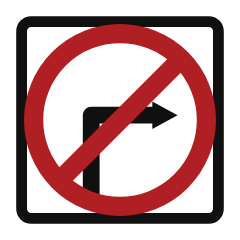
13. A driver stopped at a red signal wants to turn right and this sign is posted at the corner. What is permitted?
Show answer
Answer A: Nothing: the turn is barred whether the signal is red or green
The restriction works independently of the signal, so the usual permission to turn right after stopping at a red light does not exist where this sign is posted.
-
14. What should you check on the hitch before towing a trailer?
Show answer
Answer B: That the coupler is locked and the safety chains are crossed underneath
The coupler must be latched and pinned, and the chains crossed under the tongue so they cradle it if the coupling lets go.
-
15. You reach a stretch of road covered by moving flood water of unknown depth. What is the correct decision?
Show answer
Answer D: Turn around and take another route
About a foot of moving water is enough to carry away most cars, and the roadbed under the water may already be washed out, so the only safe choice is to turn around.
-
16. A separate right-turn lane leads onto the cross street and carries a yield sign. What does it require?
Show answer
Answer D: Slowing and giving way to traffic and people, stopping if needed
A yield requires you to slow, give way to traffic in the lane you are joining and to pedestrians, and stop only if that is what safety demands.
-
17. A tow truck with flashing amber lights is loading a car on the shoulder ahead. How should you treat it?
Show answer
Answer B: Give it the same room as an emergency vehicle
Tow operators, utility crews and highway workers face the same danger from passing traffic, so move over or slow down for their flashing amber lights too.
-
18. In plain words, what is understeer?
Show answer
Answer B: The vehicle keeps going straight even though the wheels are turned
Understeer means the front tires have run out of grip, so the vehicle takes a wider line than the one you steered.
-
19. You are driving along a street lined with parked cars. What should you watch for?
Show answer
Answer B: Doors opening, vehicles pulling out and pedestrians stepping from between cars
Parked cars hide people and can move without warning. Keep as much space from them as you safely can and cover the brake.
-
20. A steady green arrow pointing left is displayed for your turning lane. What does it tell you?
Show answer
Answer D: The turn is protected because conflicting traffic is being held
A steady green arrow gives a protected movement in the direction shown, although you still yield to pedestrians and to any vehicle already inside the intersection.
-
21. Why are pedestrians and cyclists a special risk on unlit streets at night?
Show answer
Answer A: Dark clothing can make them invisible until they are very close
A person in dark clothing reflects almost no light and may not appear until they are inside your stopping distance, so cut your speed where people may be about.
-
22. How much should you normally reduce your speed on a road covered with packed snow compared with dry conditions?
Show answer
Answer C: By about half
Packed snow roughly doubles the distance needed to stop, so a common guideline is to cut speed by about half. On ice, slow to a crawl.
-
23. When is passing another vehicle on the right generally permitted?
Show answer
Answer C: When the road has two or more lanes in your direction, or the vehicle ahead is turning left and there is room without leaving the pavement
Passing on the right is limited to situations where a lawful lane exists for it or the vehicle ahead is turning left, and it may never be done by driving onto the shoulder.
-
24. In heavy fog at night on a rural two-lane road, which marking best helps a driver hold position?
Show answer
Answer C: The solid white line along the right edge
Steering by the right edge line keeps a driver clear of oncoming traffic, while watching the center line tends to pull the vehicle toward it.
-
25. The passenger-side mirror on most vehicles is convex. What does this mean for the driver?
Show answer
Answer D: Vehicles in that mirror are closer than they appear
A convex mirror gives a wider view but shrinks what it shows, so a vehicle looks smaller and therefore farther away than it really is. Allow for this before changing lanes.
-
26. The driver ahead of you is straddling the lane line and is not signaling. How should you respond?
Show answer
Answer B: Stay back until you can see which lane that driver will take
A vehicle astride the line could move either way, so the only safe place is behind it where both possibilities are still covered.
-
27. You are following a large truck on a two-lane road and cannot see past it. What should you do before deciding to pass?
Show answer
Answer D: Drop back so that your view of the road ahead opens up
Distance is what buys you a view around a large vehicle, and no decision to pass can be made from a position where you cannot see.
-
28. Another driver takes a right of way that was legally yours. What should you do?
Show answer
Answer A: Give way to the other driver and avoid the crash, whatever the law says
Right of way is something you give, not something you take, and being in the right is no protection in a collision.
-
29. On a two-way street, where and how should you park at the curb?
Show answer
Answer C: On the right side, facing the way traffic moves
On a two-way street you must park on the right, headed in the direction of travel; parking facing traffic is prohibited.
-
30. You want to reverse direction but the street is too narrow for a U-turn. What is the alternative?
Show answer
Answer D: Make a three-point turn, or go around the block in heavy traffic
Where there is not enough width for a U-turn, the three-point turn does the job in stages, and on a busy street going around the block is safer still.
-
31. A large panel mounted on a trailer at the roadside displays a flashing arrow pointing left. What does it tell you?
Show answer
Answer B: Move into the lane to your left
An arrow panel directs traffic out of a closed lane, so the arrow shows the direction you must move rather than the shape of the road ahead.
-
32. A sign at the signal reads LEFT TURN ON GREEN ARROW ONLY. The ball turns green but no arrow appears. What may you do?
Show answer
Answer C: Wait, because your turn is allowed only while the arrow is showing
The sign removes the permissive turn, so the left is legal only during the green arrow and you must wait behind the line until it appears.